

5 Financial Services Marketing Metrics That Matter in 2026
By ProGrowth Team · Published
Financial services marketing in 2026 depends on revenue-focused KPIs, not vanity metrics. This guide covers CAC by segment, LTV:CAC ratio, payback period, attribution quality, and ROMI — with formulas, benchmarks, common mistakes, optimization tips, and a practical scorecard template.
ProGrowth Team
May 21, 2026
From CAC to ROMI: The KPIs Defining Financial Marketing in 2026
Most financial services marketing teams can tell you their click-through rates and lead volume. Far fewer can tell you their true customer acquisition cost by segment, their LTV:CAC ratio, or what percentage of closed revenue traces back to marketing. That gap is a growth problem.
In 2026, the financial services marketing metrics that matter are the ones tied directly to revenue, retention, and unit economics. This guide covers the five metrics your team needs to track, the 2026 benchmarks to measure against, and the mistakes most FinServ marketers make along the way.
1. Customer Acquisition Cost (CAC) by Channel and Segment
The Formula
CAC = Total Marketing + Sales Spend / Number of New Customers Acquired
The denominator matters as much as the numerator. A blended CAC figure hides which segments and channels are profitable and which are draining budget.
2026 Benchmarks
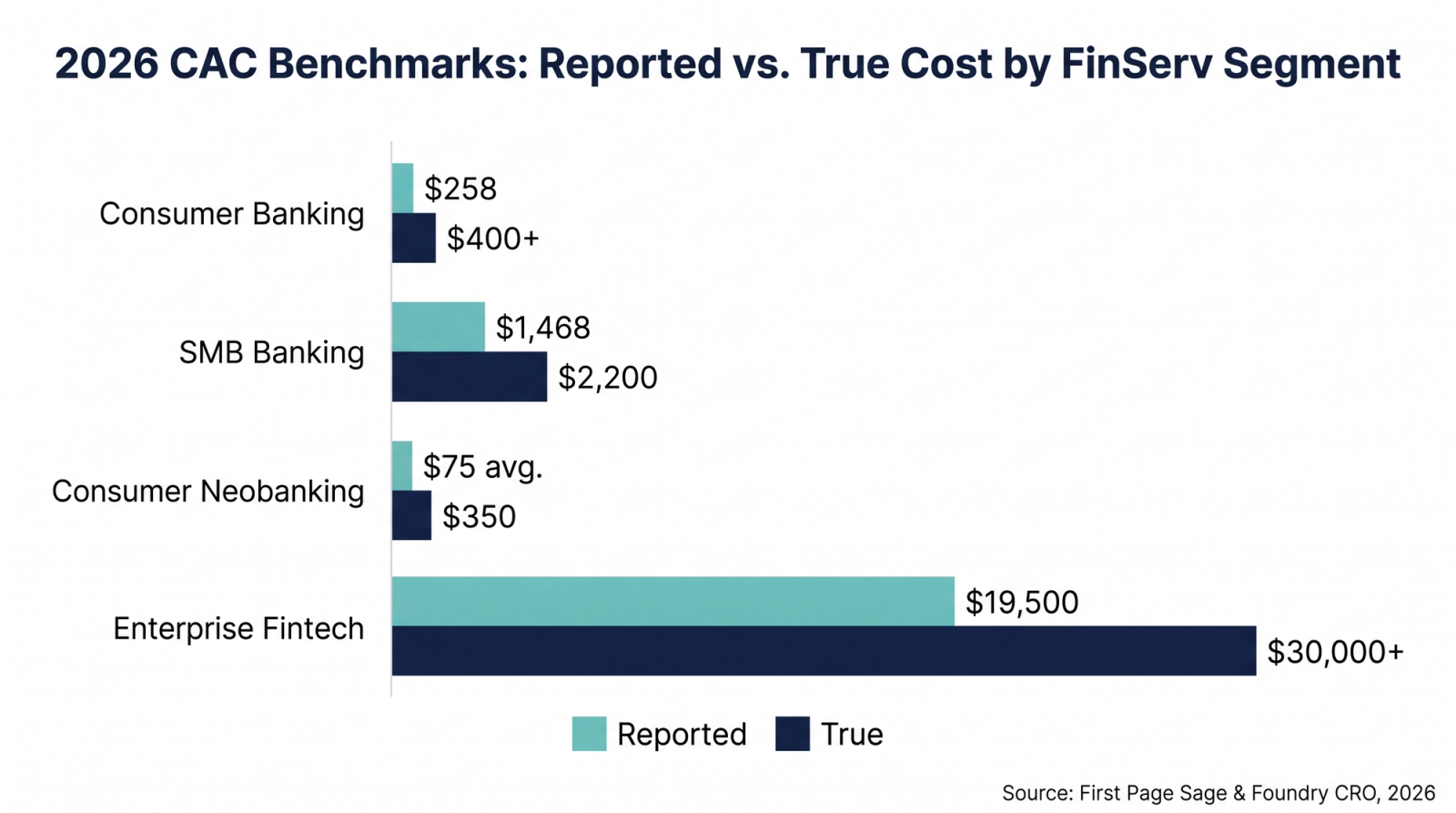
CAC varies enormously across financial services. According to First Page Sage, consumer banking CAC sits around $258, while SMB banking climbs to $1,468. Fintech data from Foundry CRO shows consumer neobanking reporting CAC of $50–$100, but the true acquisition cost, once you add KYC costs ($5–$15), sign-up bonuses ($25–$250), card issuance, and activation rate adjustments, rises to $85–$350 per activated customer. Enterprise fintech CAC ranges from $14,000 to $25,000+.
| Segment | Reported CAC | True CAC (2026 Est.) |
| Consumer Banking | ~$258 | $258–$400+ |
| SMB Banking | ~$1,468 | $1,500–$2,200 |
| Consumer Neobanking | $50–$100 | $85–$350 |
| Enterprise Fintech | $14,000–$25,000+ | $20,000–$40,000+ |
Sources: First Page Sage Financial Services Benchmarks; Foundry CRO Fintech Marketing Benchmarks 2026
Common Mistake
Reporting a single blended CAC across all channels and customer segments. A $300 blended CAC sounds reasonable until you break it down and discover paid social is driving $800 CAC on transient consumers while organic search is pulling in $150 CAC on creditworthy small business owners.
How to Improve
Build your CAC report in two dimensions: channel and segment. Track all acquisition-adjacent costs, including onboarding, activation incentives, and compliance-related KYC friction. If your reporting tool cannot separate CAC by segment, that is the first infrastructure issue to fix before scaling any channel. ProGrowth's lead generation approach for fintechs is built on this exact segmentation logic from day one.
2. LTV:CAC Ratio – and Why the Ratio Alone Is Not Enough
The Formula
LTV = Average Annual Revenue per Customer × Gross Margin % × Average Customer Lifespan (Years)
LTV:CAC Ratio = LTV / CAC
2026 Benchmarks
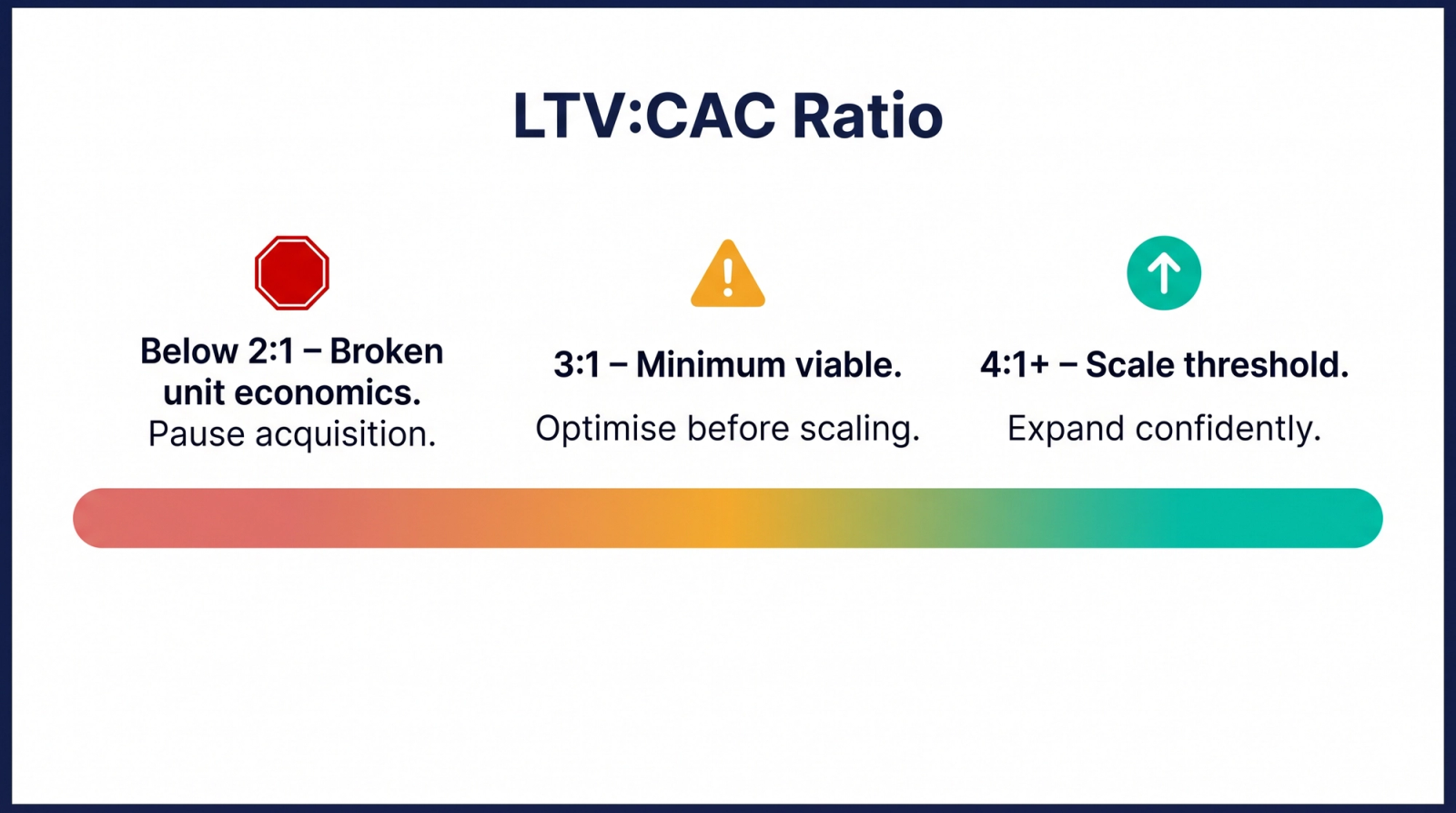
The financial services industry standard is a 3:1 LTV:CAC ratio as the minimum viable threshold. A 4:1 ratio is the target before scaling spend. Research from GoodFirms confirms: fintech teams that scale marketing before reaching 4:1 consistently accelerate spend on a model that has not been validated. The outcome is higher burn, not higher growth.
Below 2:1 → Unit economics are broken. Pause paid acquisition and focus on improving conversion rates and customer retention.
3:1 → Minimum viable ratio. Optimise campaigns, onboarding, and funnel efficiency before scaling spend.
4:1+ → Strong growth threshold. You can confidently increase investment in high-performing acquisition channels.
Common Mistake
Treating LTV:CAC as a quarterly board metric rather than an operational signal. Many financial services marketers calculate it once during planning and never revisit it when they change channels, offers, or customer segments. A 4:1 average can hide a 1.5:1 ratio on your fastest-growing segment.
How to Improve
Calculate LTV:CAC by cohort and by acquisition channel, not just in aggregate. More importantly, shift your reporting focus to CAC payback period alongside the ratio. For capital-intensive financial services businesses, how long it takes to recover acquisition cost has a direct connection to cash runway. That is the metric covered next.
3. CAC Payback Period – The Metric That Connects Marketing to Finance
The Formula
CAC Payback Period = CAC / Monthly Gross Margin per Customer
This is the number of months it takes to recover the cost of acquiring a customer. It converts your LTV:CAC ratio into a cash flow timeline.
2026 Benchmarks
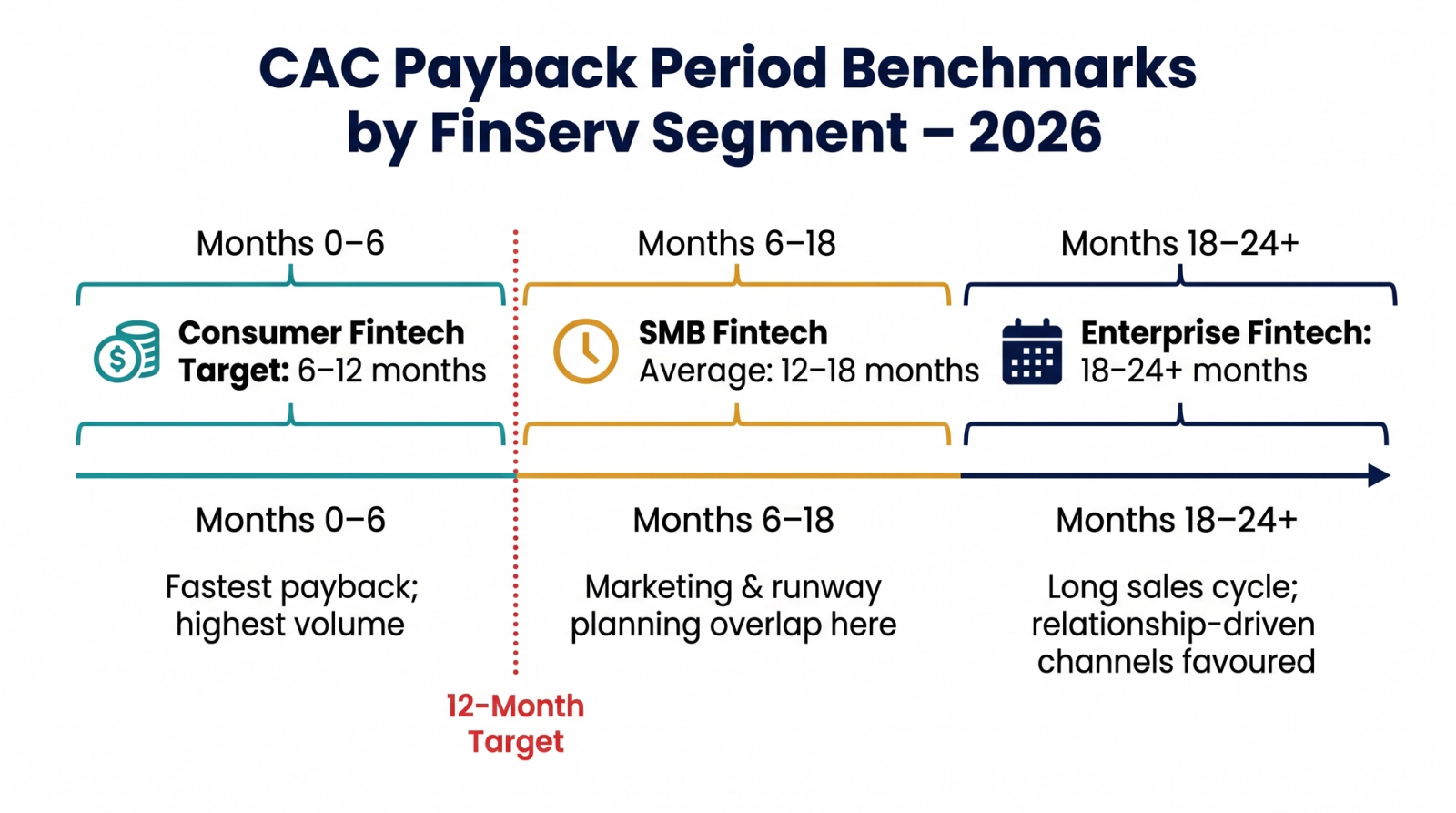
Consumer fintech: 6–12 months payback target
B2B and SMB fintech: Average 12–18 months; many teams operating at 18–24 months
Target for FinServ marketing teams to operate sustainably: under 12 months
Research from GoodFirms (2026) states that in B2B fintech, "marketing investment and cash runway decisions are the same decision, not separate ones." This is why payback period deserves a standing line in every marketing review, not just the CFO's spreadsheet.
Common Mistake
Setting a 12-month payback target at the channel level, then averaging it across high-performing and underperforming segments. A paid search campaign with a 9-month payback looks less attractive when blended with a partnership channel dragging payback to 22 months, even though paid search deserves more budget.
How to Improve
Report payback period by channel and by customer tier. Prioritise channels that demonstrate under 12 months payback with consistent volume before expanding into channels that require longer recovery windows. For FinServ companies managing compliance costs and longer onboarding cycles, this segmented view often reveals that content-driven organic acquisition outperforms paid on a lifetime-adjusted basis, even if paid looks cheaper on a cost-per-lead report.
4. Pipeline and Attribution Quality – Where AI-Influenced Journeys Break Last-Click Models
The Framework
Pipeline quality is not a single formula. It is a diagnostic built from three questions:
What percentage of closed-won revenue can be traced to a marketing-sourced touchpoint?
How accurately does your attribution model reflect the actual buyer journey?
Which channels are generating leads that convert, not just leads that enter the funnel?
2026 Benchmarks
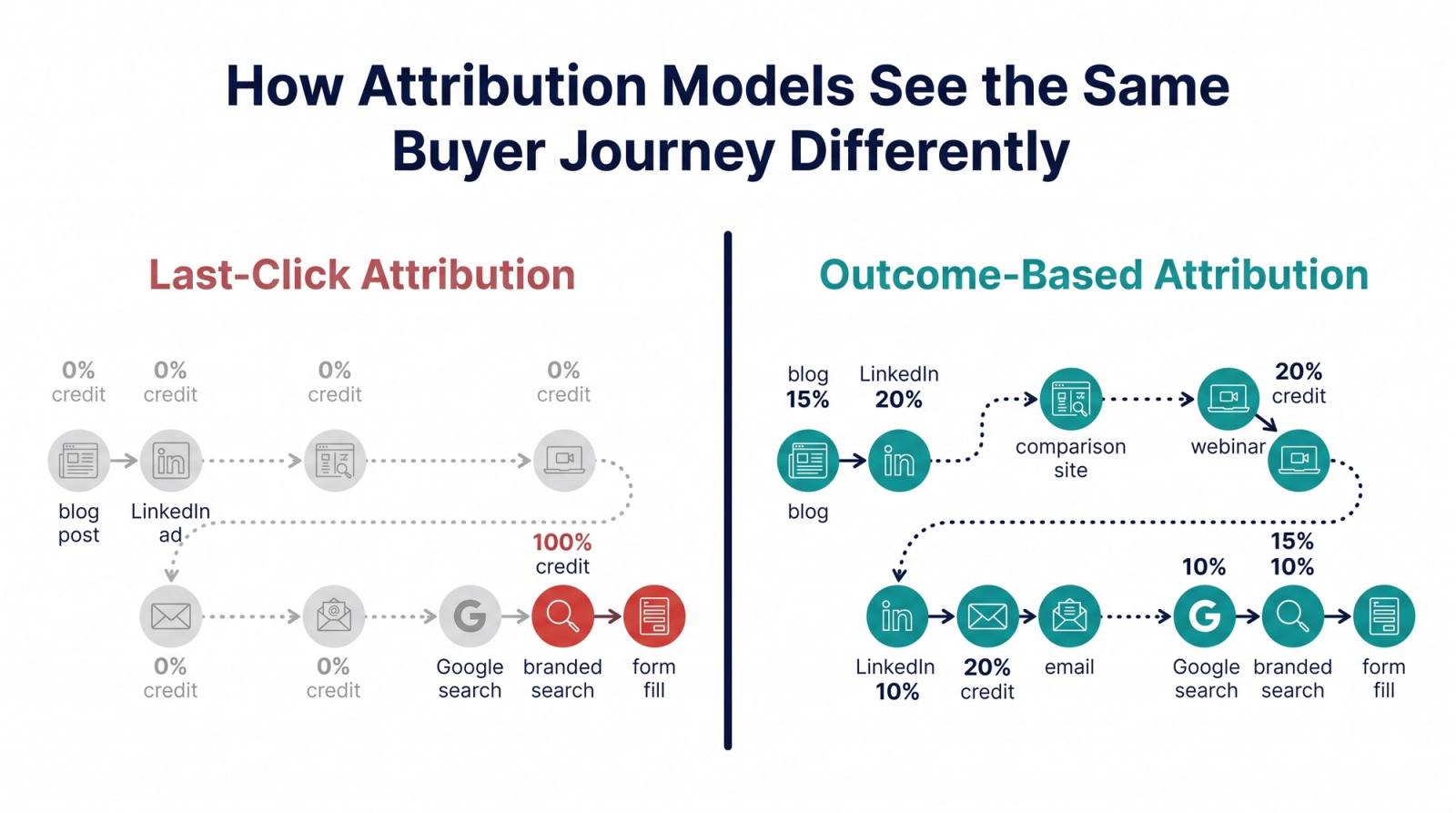
Financial services buyers in 2026 interact with an average of 7–10 digital touchpoints before engaging with sales, including AI-assisted research tools, comparison platforms, and content syndication. Last-click attribution assigns 100% of conversion credit to the final touchpoint before form fill, which, in most FinServ journeys, is either a branded search or a direct visit. This means every upper-funnel investment, including thought leadership, SEO, and content, gets zero attribution credit in a last-click model.
Outcome-based attribution, which weights touchpoints by their demonstrated contribution to pipeline conversion, consistently shows that content and SEO generate 2–4x more pipeline influence than last-click models credit them for.
Common Mistake
Using last-click attribution to evaluate channel ROI, then defunding the content and organic channels that are actually driving awareness and consideration before the final conversion. This is especially damaging in financial services, where trust-building happens across a 60–180 day research window before a prospect ever contacts sales.
How to Improve
Move to a multi-touch or outcome-based attribution model. At minimum, implement linear attribution or time-decay attribution as an interim step while you build toward a data-driven model. The goal is a reporting layer that can answer: "Which channels are influencing deals that close?" not just "Which channel got the last click?"
ProGrowth's performance marketing services include advanced attribution setup and full-funnel analytics specifically designed for regulated financial services environments where tracking constraints add complexity to this challenge. If your current marketing stack cannot answer "how did this customer hear about us before they converted," your attribution infrastructure needs attention before your channel mix does.
Pair attribution work with AI-assisted marketing services to model pipeline influence across longer buying cycles and AI-mediated research journeys, which now account for a growing share of FinServ discovery.
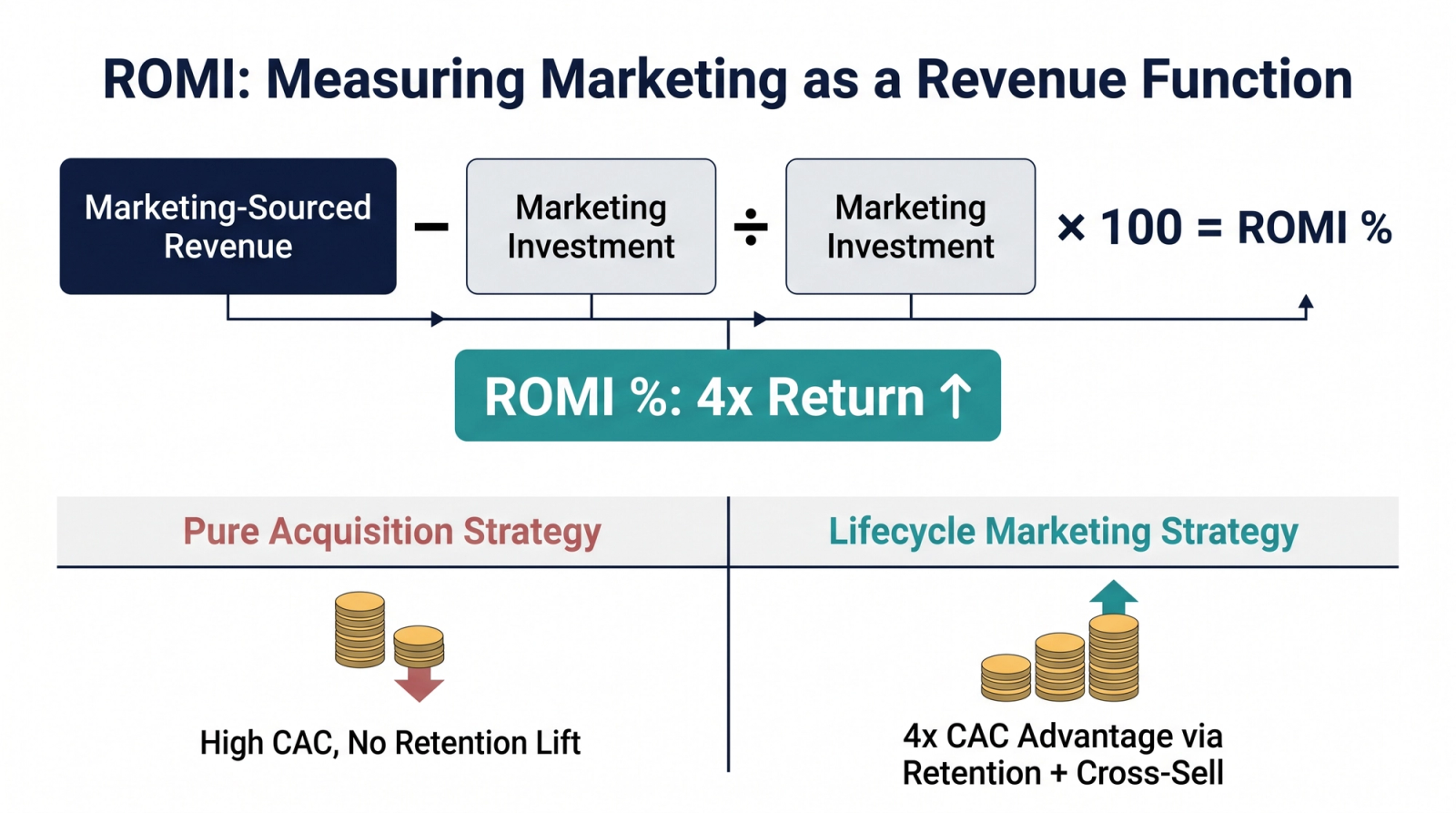
ROMI = (Marketing-Sourced Revenue − Marketing Investment) / Marketing Investment × 100
Marketing-sourced revenue is the subset of closed revenue where marketing owned or influenced the original introduction. ROMI converts this into a ratio showing return per dollar of marketing spend.
2026 Benchmarks
There is no single industry ROMI benchmark because reporting standards vary. What research consistently confirms is directional:
Financial services firms that invest in lifecycle marketing (onboarding, cross-sell, retention) see a 4x CAC advantage compared to pure acquisition strategies, because they are generating revenue from existing relationships rather than paying to acquire new ones.
Companies that track marketing-sourced revenue separately from marketing-influenced revenue consistently find that marketing's true contribution to revenue is 3–5x higher than what leadership sees in last-touch attribution models.
Common Mistake
The most damaging mistake in financial services marketing is positioning marketing as a cost centre rather than a revenue function. When marketers report leads and content output rather than pipeline generated and revenue sourced, budget conversations default to cost reduction rather than return optimisation. Marketing becomes a support function. ROMI framing corrects this.
How to Improve
Define and document a clear methodology for what qualifies as "marketing-sourced" revenue in your organisation, then report this number at every leadership review alongside CAC and LTV:CAC. Start with a conservative definition (e.g., inbound leads where marketing owned first touch) and expand it as your attribution infrastructure improves. Tie marketing budget requests to ROMI projections, not activity metrics.
Your 2026 Financial Services Marketing Metrics Scorecard
Use this one-page template in your monthly and quarterly marketing reviews. Fill in your actuals and compare against the 2026 benchmarks.
FinServ Marketing Metrics Scorecard – Q[X] 2026
| Metric | Formula | Your Benchmark | 2026 Industry Benchmark | Status |
| CAC (by segment) | Total spend / New customers | $ _______ | Consumer: ~$258 / SMB: ~$1,468 | 🟢 / 🟡 / 🔴 |
| LTV:CAC Ratio | LTV / CAC | _____ : 1 | 3:1 minimum / 4:1 target | 🟢 / 🟡 / 🔴 |
| CAC Payback Period | CAC / Monthly gross margin | _______ months | Target: <12 months | 🟢 / 🟡 / 🔴 |
| Marketing Attribution Coverage | % of pipeline with tracked marketing source | ______ % | Target: >60% touchpoint coverage | 🟢 / 🟡 / 🔴 |
| Marketing-Sourced Revenue (ROMI) | (Revenue − Spend) / Spend × 100 | ______ % | Varies; positive ROMI on all active channels | 🟢 / 🟡 / 🔴 |
Scoring Guide
🟢 On track: Meets or exceeds benchmark
🟡 Watch: Within 20% of benchmark; optimise now
🔴 Action required: More than 20% below benchmark; investigate root cause before scaling
Recommended Cadence
CAC by segment: Monthly
LTV:CAC ratio: Quarterly (or when segment mix changes)
CAC payback period: Quarterly
Attribution coverage audit: Monthly
ROMI report to leadership: Monthly
The Measurement Layer Most FinServ Marketing Teams Are Missing
The five metrics in this guide are not new ideas. What is new in 2026 is the infrastructure required to calculate them accurately: an attribution model that survives AI-influenced buyer journeys, LTV:CAC tracking by segment and channel, and a reporting layer that connects marketing activity to closed revenue.
Most financial services marketing teams have the ambition. They lack the measurement layer that makes these metrics actionable.
ProGrowth builds this layer for FinServ and B2B financial companies: attribution setup, LTV:CAC reporting by segment, and ROMI frameworks that give leadership teams a clear line of sight from marketing investment to revenue growth.
If your marketing team cannot answer all five scorecard questions above with current data, that is the starting point.
Request a Free Marketing Audit →
Our marketing audit maps your current metrics coverage, identifies the gaps in your attribution and CAC reporting, and delivers a prioritised plan to build the measurement infrastructure your growth strategy depends on.
Never Miss Our Latest Insights
Get exclusive B2B marketing strategies, AI automation tips, and growth tactics delivered straight to your inbox every week.
We respect your privacy. Unsubscribe at any time.