

Why Your Robotics/Deep Tech Company's Marketing Isn't Working (Lessons from 23 DeepTech Companies)
Deep tech founders need marketing agencies for technology brands that understand long sales cycles. Analysis of 30 Deeptech companies reveals how b2b tech marketing agencies translate specs into ROI-focused messaging.
ProGrowth Team
February 5, 2026
You've architected something extraordinary. Your robotics platform processes sensor fusion at microsecond latency. Your autonomous system navigates GPS-denied environments with unprecedented precision. The engineering is genuinely impressive—MIT spinout, $18M Series B, patents pending in seven jurisdictions.
Your website opening statement: "Our autonomous robotic system uses simultaneous localization and mapping algorithms with LiDAR sensor arrays and convolutional neural networks."
Your RFP win rate: 3%.
Over the past two quarters, I've conducted in-depth conversations with more than 30 deep tech founders and CEOs across robotics, quantum computing, and advanced materials. These discussions revealed a consistent pattern: exceptional technical founders demonstrating remarkable perseverance to sustain and launch genuinely innovative products, yet struggling with the translation from technical excellence to market traction.
At ProGrowth, we specialize exclusively in deep tech marketing—working with Series A-C robotics, quantum computing, and advanced materials companies navigating exactly this transition. The patterns we've identified across these conversations reveal systematic, fixable challenges.
The market opportunity is substantial. According to CB Insights' deep tech analysis, the global deep tech market is projected to grow from $150 billion in 2025 to $476 billion by 2034—representing a 12-21% CAGR, driven primarily by AI, quantum computing, and robotics innovations. The United States accounts for more than 60% of this investment, with Boston and Toronto emerging as critical innovation hubs.
Yet after analyzing 23 deep tech companies across Boston's Route 128 corridor, Cambridge's Kendall Square (home to one of the world's most concentrated robotics clusters), and Toronto's MaRS District, we documented a consistent pathology: exceptional technical execution coupled with inadequate market positioning. The issue isn't technical inaccuracy—it's assuming enterprise buyers evaluate solutions through the same technical lens you apply when architecting them.
The Technical Founder's Marketing Paradox
Often your strong technical skills and obsession with the solution/product undermine your ability to communicate value to non-technical stakeholders. This paradox is why many technical founders eventually partner with a deep tech marketing agency that understands both domains.
When a Fortune 500 operations director evaluates autonomous inspection systems, they're not assessing algorithmic elegance. They're asking, "Will this reduce my inspection costs? By how much? What's the implementation risk?"
This is where a marketing agency for technology brands becomes critical—translating technical specifications into operational outcomes without sacrificing technical credibility.
The Core Marketing Mistakes Technical Founders Make
Mistake #1: Leading with Technology Instead of Business Outcomes
Pattern: 21 of 23 companies led their homepage with technical architecture rather than business value.
Example: "AI-powered predictive maintenance using federated learning across distributed edge devices."
Enterprise buyers optimize for risk-adjusted ROI, not algorithmic novelty. A Toronto quantum sensing company restructured their value proposition: "Reduce MRI machine costs by 70% while improving diagnostic resolution." This increased their qualified pipeline by 340% within 90 days.
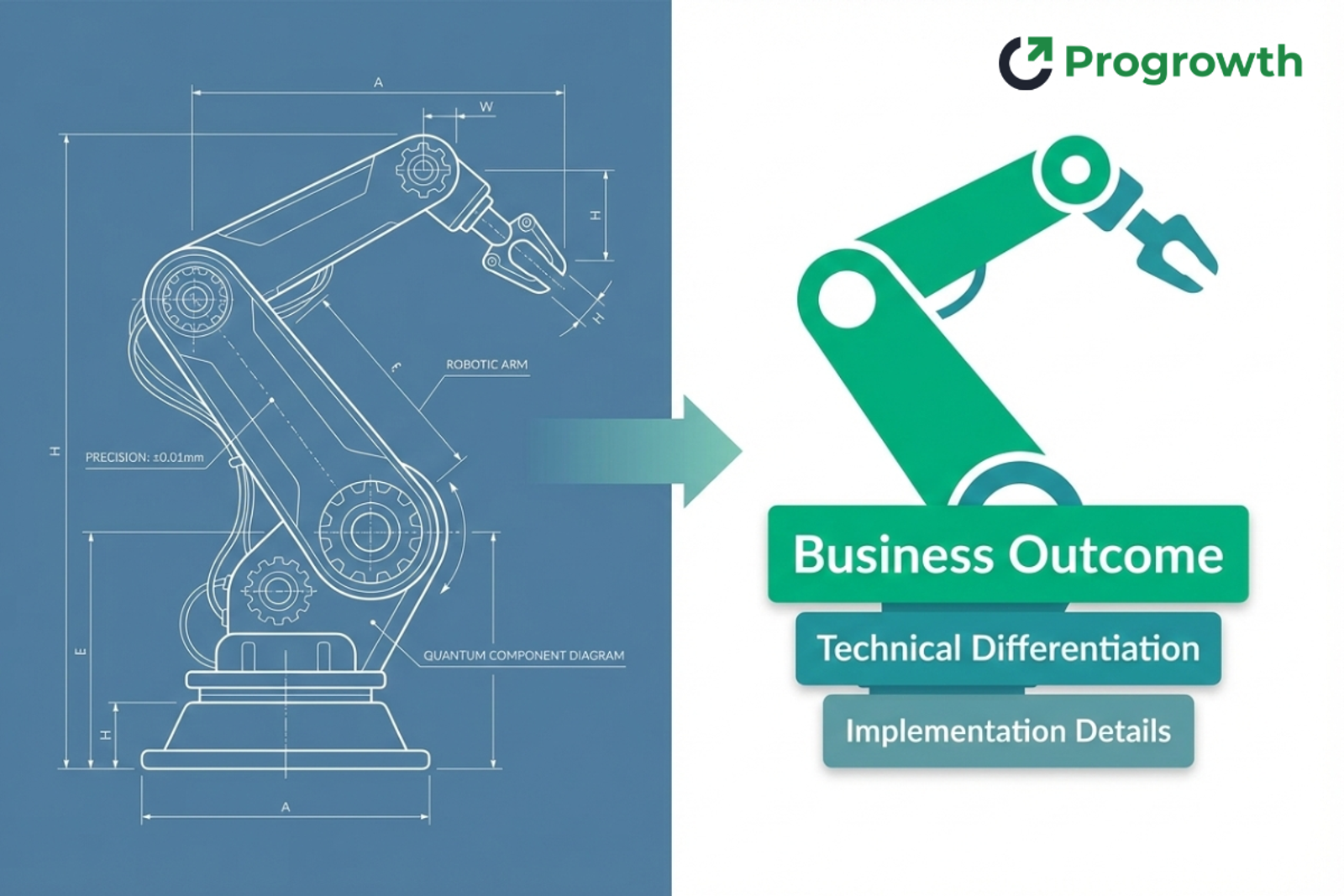
The right marketing agency for technology brands understands this hierarchy: business outcomes first, technical differentiation second, implementation details third.
Mistake #2: Assuming Technical Sophistication Equals Market Understanding
Observation: 19 of 23 companies had no one with B2B enterprise sales experience in the founding team.
Technical founders confuse domain expertise with market competence. You're selling to procurement (process compliance), finance (capital efficiency), operations (implementation risk), and IT (integration complexity). Your platform must simultaneously satisfy all stakeholders—yet most pitch decks address only the technical evaluation.
This is where engaging a deep tech marketing consultant who understands both technology and enterprise buying behavior becomes non-negotiable. They bridge the gap between technical capability and buyer decision-making processes, helping founders understand that enterprise buyers evaluate solutions through business impact rather than technical sophistication.
Mistake #3: Treating Marketing as Tactical Execution
Observation: 22 of 23 companies viewed marketing as a support function rather than strategic positioning.
Marketing for deep tech isn't graphic design. It's market segmentation, positioning strategy, messaging hierarchy, and channel strategy. As Harvard Business Review notes on marketing intangible products, deep tech companies face unique challenges communicating value for technically complex, non-tangible innovations.
This is the core value proposition of a b2b tech marketing agency specialized in deep tech: strategic thinking that complements technical expertise. High-tech marketing firms understand that positioning strategy must come before producing collateral.
Additional Critical Failures
Beyond these three: No Clear ICP (saying "any manufacturer" instead of specific verticals—companies with vertical focus had 9.2 vs. 16.7 month sales cycles), Documentation ≠ Marketing (technical specs without case studies or ROI calculators), and Missing Middle Funnel (no content for the 6-12 month consideration period).
Five Critical Lessons from 30+ Deep Tech Founder Conversation
Through ProGrowth's work with over 30 deep tech CEOs over the past two quarters, several non-obvious patterns emerged:

Your Grandmother Doesn't Need to Understand Your Messaging
Conventional marketing insists messaging should be simple enough for a five-year-old. This actively harms deep tech marketing. Your buyers are technical directors at Fortune 500 companies who speak technical language fluently and distrust oversimplified messaging. One robotics founder told me: "When we pitched to the VP of Manufacturing, he said, 'I need to know *how* you achieve this. Without technical details, I can't validate your claims.'"
You need hierarchical messaging—business outcomes for executives, comprehensive technical validation for engineers. Both layers must coexist.
PLG and B2C Techniques Don't Translate
One quantum computing founder ran Facebook ads and got 500 leads. Only 2 were actual enterprise prospects with budget authority; 498 were academics and students. Deep tech requires precision targeting over volume—50 perfectly qualified leads, not 500 random prospects. Account-based tech startup marketing automation for deep tech targets specific companies with your technical solution, allocated budget, and organizational readiness.
Get Positioning Right Before Execution
The most consistent failure: founders skip straight to tactical marketing (conferences, email campaigns, LinkedIn ads) without strategic positioning. One Boston robotics founder spent $180,000 on six conferences, generated 47 leads but only 3 qualified opportunities and zero deals.
Without strategic positioning, tactical execution generates noise rather than traction. A b2b tech marketing agency specializing in deep tech knows positioning strategy must precede execution. The sequence matters: strategic positioning → messaging architecture → content strategy → tactical execution. Most founders hire for tactical execution first and wonder why their marketing doesn't work.
Design for Multi-Year Sales Cycles
Deep tech sales to Fortune 500 rarely close under 12 months. One founder lost a deal six months in because they lacked implementation guides and ROI calculators for the CFO. Marketing must support 18+ month timelines with nurture sequences, middle-funnel education, and late-stage business case materials. And critically: no "AI slop content"—technical evaluators immediately recognize generic, AI-generated content lacking genuine domain expertise.
Ruthlessly Customize Messaging by Stakeholder
The R&D director cares about computational complexity. The CFO cares about ROI timeline. The CEO cares about strategic differentiation. Same product, completely different evaluation criteria. Companies that crack their first 10 enterprise clients have crystal-clear positioning, strategic patience, and messaging that resonates with actual decision-makers—not everyone.
The Business Value Translation Framework
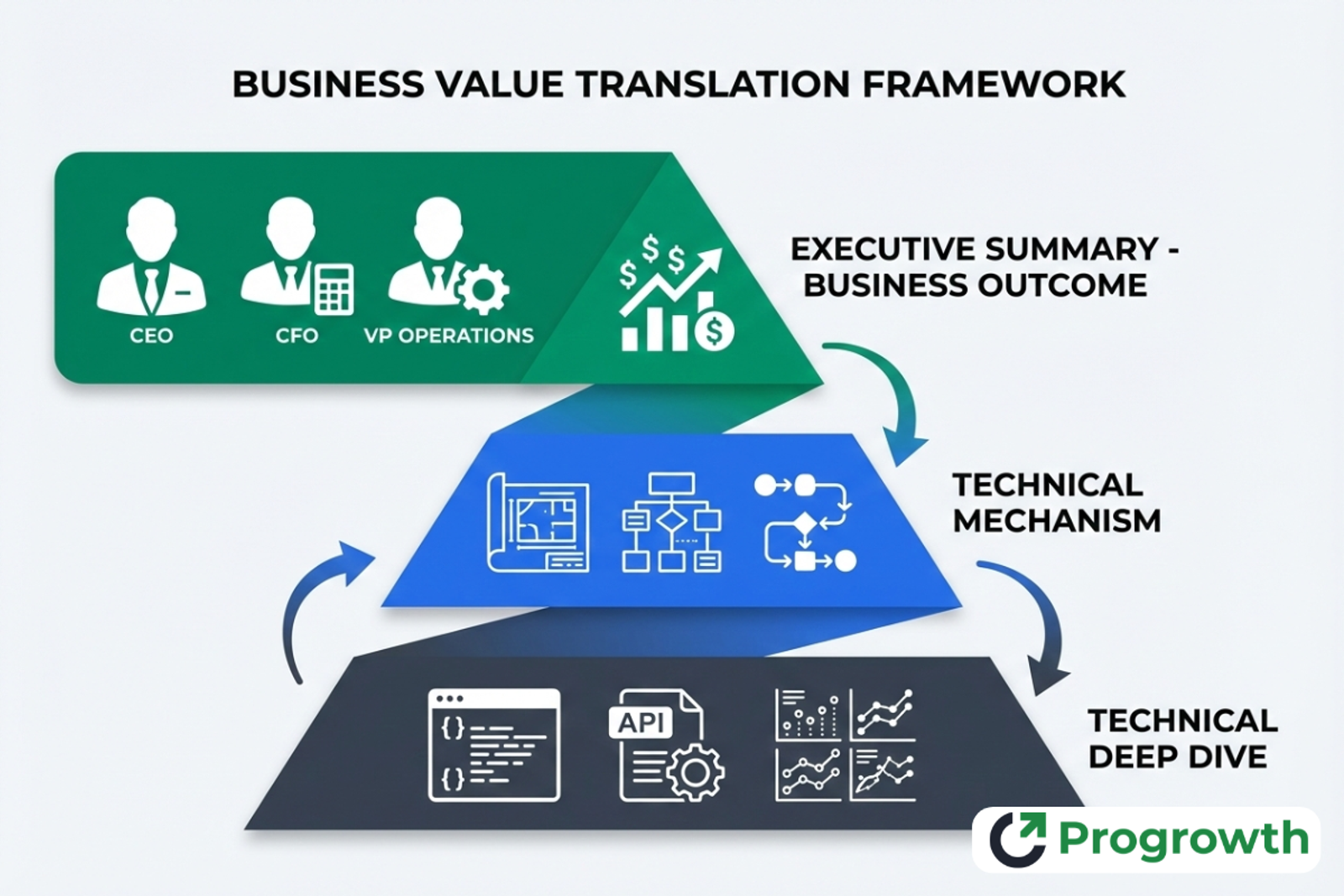
Use the Three-Layer Messaging Hierarchy:
Layer 1: Executive Summary (Business Outcome)
Bad: "Our autonomous inspection system uses proprietary LiDAR-based SLAM with real-time semantic segmentation."
Good: "Our autonomous inspection system enables automotive manufacturers to reduce quality inspection costs by 68% while detecting 2.3x more defects, eliminating the $2.7M average cost of a single recall event."
Layer 2: Technical Mechanism (How It Works)
"We achieve 68% cost reduction and 2.3x defect detection by combining LiDAR-based SLAM for autonomous navigation with deep learning-based computer vision trained on 2.7 million labeled manufacturing defects. This enables real-time 3D reconstruction at production line speeds—impossible with either static vision systems or manual inspection."
Layer 3: Technical Deep Dive (The Proof)
Comprehensive technical specifications, architectural diagrams, API documentation, performance benchmarks, limitation disclosures, integration requirements.
Marketing Technology for Deep Tech
B2B SaaS platforms (HubSpot, Marketo) are poorly suited for deep tech with long sales cycles and complex stakeholder maps. While these platforms work well for product-led growth companies with 30-60 day sales cycles, they lack the sophisticated capabilities tech startup marketing automation requires for deep tech contexts.
Tech startup marketing automation for deep tech must:
1. Track multi-stakeholder engagement from the same company
2. Enable parallel nurture tracks for different roles
3. Support 12+ month engagement timelines
4. Integrate with technical content delivery
5. Score based on organizational buying signals
This is where high-tech marketing firms with deep tech experience demonstrate value—understanding the unique requirements of long-cycle, multi-stakeholder sales processes. Working with a b2b tech marketing agency that specializes in these complex requirements prevents the common mistake of forcing SaaS marketing tools into deep tech contexts.
Case Study: How ProGrowth Helped a Cambridge Robotics Company Achieve 3% to 23% RFP Win Rate
A Cambridge-based robotics firm with $15M Series B, 47 employees (12 PhDs), and genuinely differentiated computer vision technology was losing deals to inferior competitors.
The Problem:
Homepage led with technical specs
No vertical focus (manufacturing, energy, infrastructure simultaneously)
Zero case studies
47-slide deck filled with technical details
RFP win rate: 3.2%

ProGrowth's 6-Month Intervention:
Months 1-2: We narrowed their focus to discrete manufacturing, developed business value translation framework, created stakeholder-specific messaging
Months 3-4: We rebuilt their website with outcome-first messaging, created vertical-specific case studies, developed ROI calculator, secured publication in *Manufacturing Engineering*
Months 5-6: We restructured their sales deck (12 slides business case + 35-slide technical appendix), implemented lead scoring and nurture sequences
The Results:
RFP win rate: 3.2% → 23.1%
Average deal size: $380K → $720K
Sales cycle: 18.3 months → 9.7 months
Pipeline value: +340%
Inbound qualified leads: 2/month → 11/month
The technology didn't change. What changed was their ability to articulate value in terms enterprise buyers could evaluate and champion internally.
Why Boston and Toronto Ecosystems Face These Challenges
Both Boston and Toronto have extraordinary technical talent (MIT, Harvard, University of Toronto, Waterloo), robust venture capital, and deep corporate R&D. As Boston Consulting Group's analysis shows, these create strong technical cultures where excellence is the primary currency.
The challenge emerges when transitioning from technical validation to market traction—what Geoffrey Moore called "crossing the chasm". The same factors enabling great technology development can become liabilities when communicating to non-technical buyers.
For Toronto companies entering the US market, deeptech branding strategies must work across regulatory environments and overcome geographic bias. MaRS Discovery District has produced numerous successful companies, but they often need strategic US partnerships and academic pedigree positioning. Effective deeptech branding emphasizes technical excellence while building credibility with US enterprise buyers.
What to Look for in a Marketing Partner
Based on ProGrowth's experience working exclusively with deep tech companies, here's what to evaluate when considering a deep tech marketing consultant or marketing partner:
Technical Fluency: Can they read your technical papers and engage substantively with your engineering team?
Enterprise B2B Experience: Do they understand 12+ month sales cycles, procurement, and buying committees?
Strategic First: Do they ask about category definition and value proposition—or jump to tactics?
Deep Tech Results: Request robotics/quantum/materials case studies showing RFP win rates, sales cycle improvements, deal size growth.
Ready to discuss your 2026 go-to-market strategy?

According to MIT Technology Review's ongoing analysis, the deep tech market is projected to grow from $150 billion in 2025 to $476 billion by 2034.
At ProGrowth, we've developed specialized packages specifically for deep tech founders. We work with Series A-C robotics, quantum computing, and advanced materials companies to:
Develop strategic positioning establishing defensible differentiation
Build messaging architecture translating technical advantages into business value
Create stakeholder-specific content for complex buying committees
Implement tech startup marketing automation designed for 12-18 month sales cycles
Execute account-based marketing generating qualified enterprise opportunities
We understand deep tech because we work exclusively with deep tech. We know the difference between a pilot agreement and a production deployment. We understand why your quantum coherence times matter—and how to explain that to a CFO.
Your next strategic move might not be hiring another engineer. It might be finding the right b2b tech marketing agency who can translate your technical excellence into market leadership.
We're meeting with deep tech founders in Cambridge and Boston in April 2026. Schedule a 30-minute diagnostic consultation →
Never Miss Our Latest Insights
Get exclusive B2B marketing strategies, AI automation tips, and growth tactics delivered straight to your inbox every week.
We respect your privacy. Unsubscribe at any time.