

Best Fractional CMO Services for B2B SaaS Startups: A Buyer's Guide for Founders
By Siva Cotipalli · Published
Fractional CMO services give B2B SaaS startups between $1M and $20M ARR access to senior marketing leadership at 40–70% below the cost of a full-time CMO hire. This guide covers the three-model decision framework (fractional, full-time, agency), a 90-day comparison table showing what each model delivers, current 2026 pricing benchmarks ($7,000–$12,000/month for most early-stage SaaS companies), and six practical questions for evaluating specific services. Key focus: what actually changes in the business – positioning, pipeline ownership, channel focus, sales-marketing alignment – when a fractional CMO is in place.
Siva Cotipalli
August 5, 2026
You are somewhere between $1M and $20M in annual recurring revenue. Pipeline is inconsistent, your marketing function is either headless or staffed by one junior generalist, and your board is starting to ask why growth has plateaued. A full-time Chief Marketing Officer costs more than you want to commit. An agency has already disappointed you once. Hiring a VP of Demand Gen feels like solving the wrong problem.
This guide answers the question most founders reach for at this stage: what do fractional CMO services actually deliver, what do they cost, and how do you evaluate whether a specific service is right for your company?
This is not a list of CMO job responsibilities. It is a buyer's framework for evaluating fractional marketing leadership as a service – scoped, priced, and measured against the alternatives available to a B2B SaaS company at your revenue stage.

The Decision You Are Actually Making
Before comparing services, you need to settle a prior question: which model fits your stage?
Founders often frame this as a hiring decision. It is more accurately a capital-allocation decision, and the answer changes depending on two variables – your current ARR and how much marketing infrastructure you already have in place.
At $1M–$5M ARR, most B2B SaaS companies have no dedicated marketing function at all, or one person running content, paid, and email simultaneously. The gap is not execution capacity; it is strategic direction. Nobody owns positioning, nobody has defined the ICP with precision, and outbound is driven by founder instinct. A fractional CMO addresses that gap directly. A full-time hire almost certainly does not, because a CMO-caliber operator at this stage costs more than your marketing budget.
At $5M–$12M ARR, you probably have a small team but no one senior enough to make the structural decisions that unlock the next growth phase: category positioning, channel prioritization, sales-marketing alignment, pricing messaging. This is where fractional leadership earns its fee most clearly – the work is high-leverage and the cost of getting it wrong compounds.
At $12M–$20M ARR, the calculus shifts. You may be ready for a full-time CMO if you have the budget, the board support, and a clear enough strategy that an executive can operate rather than diagnose. Fractional still makes sense if you are between hires, running a parallel process, or need someone embedded during a critical six-month window (a fundraise, a product pivot, a new market entry).
Fractional CMO vs. Full-Time CMO vs. Marketing Agency: What Each Model Delivers
The three models are not substitutes for the same need. They solve different problems and fail in different ways.
Fractional CMO
A fractional CMO is a senior marketing executive who embeds with your company on a part-time basis – typically 20 to 60 hours per month – and owns the marketing function the way a full-time executive would, without the full-time cost. The engagement runs on a monthly retainer. The executive participates in leadership meetings, owns strategy and roadmap decisions, manages any existing team or agency relationships, and is accountable to outcomes.
What this model costs (2026 benchmarks): Monthly retainers range from $5,000 to $25,000. Most B2B SaaS companies between $3M and $15M ARR land in the $7,000–$12,000 range for roughly 10 to 20 hours of senior attention per week. Annualized, that is $84,000–$144,000 – compared to $280,000–$400,000 in loaded total compensation for a full-time CMO (base salary, equity, benefits, employer taxes).
What this model fails at: Fractional leadership breaks down when your primary problem is execution volume, not direction. If you need someone running campaigns daily, managing a large paid budget hands-on, or leading a 10-person team through tactical execution, fractional hours will not cover the scope. The service is built for strategic ownership, not execution throughput.
Full-Time CMO
A full-time CMO provides dedicated capacity, cultural continuity, and deep cross-functional relationships that build over time. For companies past $20M ARR with a functioning marketing team, a significant budget to govern, and board-level reporting requirements, a full-time hire is the right model.
What this model costs: Loaded total compensation runs $280,000 on the conservative end and exceeds $400,000 at companies with meaningful equity packages. Add recruiting fees (typically 20–25% of first-year base) and a 60–90 day ramp period before the hire is productive, and the true first-year cost is substantially higher.
What this model fails at: A full-time CMO hired before your strategy is clear is an expensive way to keep diagnosing the same problem. Companies at $3M–$8M ARR frequently hire CMO-caliber leaders, watch them spend six months on discovery and positioning work, and then lose them to a larger opportunity eighteen months in. The role requires a platform to operate on. Building that platform is often what fractional leadership is for.
Marketing Agency
An agency provides execution capacity , campaign management, content production, paid media, SEO, design. It does not provide strategic ownership. An agency will run your demand-gen program; it will not make the positioning decisions, own the pipeline number, or tell you which channels to stop investing in.
What this model costs: Agency retainers for B2B SaaS typically range from $3,000 to $25,000 per month depending on scope and specialization. Performance-focused agencies cost more. Generalist agencies cost less and deliver generalist work.
What this model fails at: An agency without a strategic owner above it defaults to delivering outputs – blog posts published, ads running, emails sent – without accountability to outcomes. Most B2B SaaS founders who are frustrated with agencies are actually frustrated that no one internal or external owns the results.
The 90-Day Comparison: What Each Model Delivers
The gap between the models becomes clearest when you look at what actually happens in the first 90 days of engagement.
The table reflects the structural reality: an agency starts fastest but owns nothing. A full-time CMO takes longest to become productive and costs the most if the fit is wrong. A fractional CMO sits between them – faster to value than a full-time hire, with real ownership that an agency cannot provide.
What Actually Changes When a Fractional CMO Is in Place
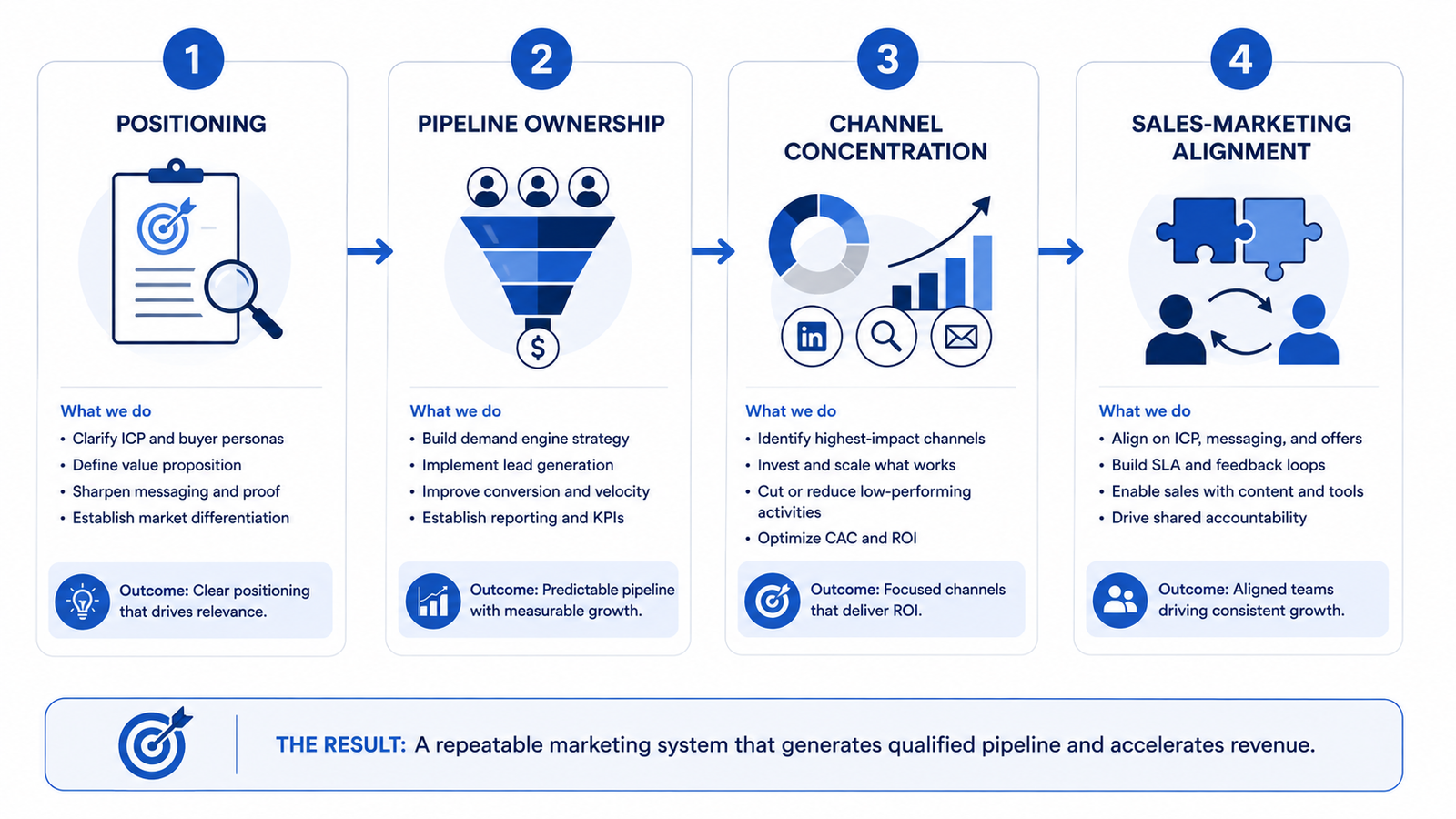
Founders who have used fractional marketing leadership consistently describe the same shift: the marketing function stops being reactive and starts running as a system. That shift has specific, observable components.
Positioning becomes a usable asset. Most early-stage SaaS companies have a positioning document somewhere. A fractional CMO does the work to make it operational – tested with prospects, embedded in sales decks, reflected in website copy, consistent across every channel. This sounds like table stakes. In practice, it rarely exists before senior marketing leadership is present.
The pipeline has an owner. A fractional CMO takes accountability for the pipeline number. Not just for marketing-attributed leads, but for the end-to-end relationship between marketing activity and revenue. This is the accountability gap that neither a junior marketing hire nor an agency fills.
Channel decisions get made, and unmade. Companies at the $3M–$15M stage often run too many channels at insufficient investment and wonder why none of them work. A fractional CMO concentrates budget and attention, kills underperforming channels, and builds conviction around two or three that can scale.
Sales and marketing start speaking the same language. ICP definition, lead qualification criteria, handoff timing, pipeline review cadence – these are sales-marketing alignment decisions that require a senior voice with credibility on both sides of the table. A fractional CMO provides that voice
How to Evaluate Fractional CMO Services: Six Questions Worth Asking
Not all fractional CMO services operate the same way. Some are individual operators; others are platforms or networks that match companies with executives from a vetted pool. Evaluating them requires looking past the positioning and into the structure of how the engagement actually runs.
1. Is the strategy work done by the person you are paying for?
Some fractional CMO services use a senior executive as the face of the engagement and then delegate the actual strategy work to a junior associate. Ask directly: who writes the positioning? Who attends the leadership meetings? Who is accountable to your pipeline targets?
2. What does the engagement scope actually include?
Most retainers define hours. The better services define deliverables – what you receive in the first 30, 60, and 90 days, and what ongoing governance looks like after that. If the scope is expressed only in hours, you are buying time, not outcomes.
3. Does the operator have SaaS-specific experience?
B2B SaaS marketing has structural differences from other categories: product-led growth mechanics, free trial conversion, annual contract value economics, churn attribution, and category creation. A fractional CMO from a services or e-commerce background will face a learning curve that costs you months.
4. How does the engagement end?
Fractional CMOs are by definition transitional. A good service provider builds toward a specific outcome – a full-time hire, a self-sustaining team, a documented playbook – not toward dependency. Ask what the off-ramp looks like and whether the engagement documentation transfers to you at the end.
5. What is the minimum commitment and the exit term?
Most fractional engagements run on 30- or 60-day rolling commitments after an initial lock-in period (commonly 90 days). Avoid services that require six- or twelve-month commitments without clear milestone-based exit provisions.
6. Can you speak with two or three previous clients at similar revenue stages?
References filtered to your ARR band and industry are more useful than general testimonials. A fractional CMO who has worked with three $5M ARR SaaS companies has a relevant track record. One whose reference clients are all $50M+ or in different industries tells you less about fit.
Pricing Bands by Revenue Stage
Use the following as a planning benchmark, not a negotiating floor. Actual rates vary by operator experience, geographic market, engagement depth, and whether execution support is included.
| ARR Stage | Recommended model | Monthly retainer range | Hours per month |
|---|---|---|---|
| $1M–$3M | Fractional CMO (strategy-only) | $5,000–$8,000 | 15–20 hrs |
| $3M–$8M | Fractional CMO (strategy + light oversight) | $8,000–$12,000 | 20–30 hrs |
| $8M–$15M | Fractional CMO (embedded leadership) | $12,000–$20,000 | 30–50 hrs |
| $15M–$20M | Fractional or full-time (evaluate both) | $15,000–$25,000 | 40–60 hrs |
| $20M+ | Full-time CMO | $280,000–$400,000+/yr (loaded) | Full-time |
Source: Synthesized from 2026 market benchmarks across Treetop Growth Strategy, gRO, and Fractional Pulse published pricing data.
Red Flags to Watch When Comparing Services
A few patterns reliably predict a fractional CMO engagement that underdelivers.
Vague deliverables in the contract. If the statement of work lists hours and meeting cadence but no specific outputs, the engagement will drift. Ask for a sample 90-day plan before signing.
No prior B2B SaaS clients in your ARR range. General marketing expertise does not transfer cleanly to SaaS. Pipeline economics, product-led growth, and annual contract optimization are specific disciplines.
Guaranteed results before diagnosis. A fractional CMO who commits to specific pipeline numbers before doing an ICP audit and a channel assessment is either guessing or overpromising. Legitimate services scope a discovery phase first, then set targets.
Hourly pricing. Most reputable fractional CMO services work on monthly retainers, not hourly. Hourly pricing incentivizes time, not outcomes.
No clear handoff plan. Fractional is, by design, a transitional model. If the service provider has no answer to "what does this engagement look like in 18 months," that is a structural problem.
Related Reading
If you are earlier in this evaluation, two related resources cover adjacent decisions:
Fractional CMO services for SaaS companies – a deeper look at how fractional marketing leadership is structured specifically for software companies.
How a fractional CMO can boost small business revenue in 2026 – a practical overview of how companies at earlier revenue stages measure impact from fractional marketing leadership.
FAQ: Fractional CMO Services for B2B SaaS
What is a fractional CMO and how is it different from a marketing consultant?A fractional CMO operates as an embedded executive – attending leadership meetings, managing your marketing team or vendor relationships, and owning the pipeline number. A consultant delivers a defined project (a brand audit, a competitive analysis) and exits. The fractional CMO stays and is accountable to ongoing results, not deliverable completion.
How long does a typical fractional CMO engagement last?Most B2B SaaS engagements run 6 to 18 months. Shorter engagements (3 to 6 months) are common for specific events – a fundraise, a product launch, a GTM reset. Longer engagements typically transition to a full-time hire or a reduced advisory retainer.
Can a fractional CMO manage my existing marketing team?Yes. Managing an existing team is one of the most common fractional CMO use cases. The executive provides the strategic direction and management layer that a junior marketing hire or an agency cannot provide. They set priorities, run performance reviews, and align the team to pipeline goals.
Is fractional CMO the same as fractional marketing?Not exactly. Fractional marketing is a broader category that includes fractional content strategists, fractional demand-gen leads, and fractional brand managers. A fractional CMO is specifically a C-suite equivalent – someone who owns the entire marketing function, not a specific channel or discipline.
What is the typical notice period to end a fractional CMO engagement?Most contracts require 30 to 60 days' notice after an initial lock-in period. Review the contract for minimum commitment terms (commonly 90 days) and ensure the notice terms are mutual.
How do I know if I need a fractional CMO or just a better agency?If your problem is execution volume – you have a clear strategy but not enough capacity to run it – an agency is likely the right answer. If your problem is strategic direction – unclear positioning, no pipeline ownership, weak ICP definition, disconnected sales and marketing – a fractional CMO addresses the root cause. Many companies find that adding a fractional CMO above an existing agency relationship dramatically improves what the agency produces.
Conclusion
Fractional CMO services are a specific solution to a specific problem: B2B SaaS companies that need senior marketing leadership before they can justify or afford a full-time executive hire. For companies between $1M and $20M ARR, the model provides real ownership and strategic accountability at 40 to 70 percent below full-time CMO cost, with a faster ramp than a full-time hire and more accountability than any agency can offer.
The quality of the service depends heavily on the operator behind it – their SaaS experience, their engagement structure, and whether they build toward a clear outcome rather than an indefinite retainer. Use the six evaluation questions in this guide, ask for references at your revenue stage, and insist on a 90-day deliverable plan before you sign anything.
If you are evaluating fractional CMO services for your SaaS company, the decision framework above gives you the structure to compare options against your current stage and team – and to recognize when fractional is the right model and when it is not.
Never Miss Our Latest Insights
Get exclusive B2B marketing strategies, AI automation tips, and growth tactics delivered straight to your inbox every week.
We respect your privacy. Unsubscribe at any time.