

How AI Is Changing Financial Services Marketing
By ProGrowth Team · Published
About 94% of financial firms are testing generative AI, but few see strong marketing results. Success in 2026 depends on shifting from SEO to GEO, improving AI attribution, and building compliant, measurable AI-driven marketing systems.
ProGrowth Team
May 19, 2026
How AI Is Changing Financial Services Marketing (And Why Most Firms Are Still Getting It Wrong)
Nearly every major bank, insurer, and fintech now has an AI pilot running somewhere. According to Databricks' 2026 Financial Services Outlook, roughly 94% of financial services firms are piloting or deploying generative AI within core business functions. That number sounds like a success story.
It isn't. Not yet.
The same report makes the uncomfortable part explicit: the impact is uneven. Most firms are not realising measurable gains. Decisions are not faster. Budgets are not leaner. The models exist – the execution doesn't. And nowhere is that execution gap wider than in marketing.
This article breaks down what is actually happening in financial services marketing in 2026, where AI is delivering and where it is stalling, and what the path forward looks like for regulated brands that want results, not pilots.
Section 1: AI Is Replacing Search as the Discovery Starting Point
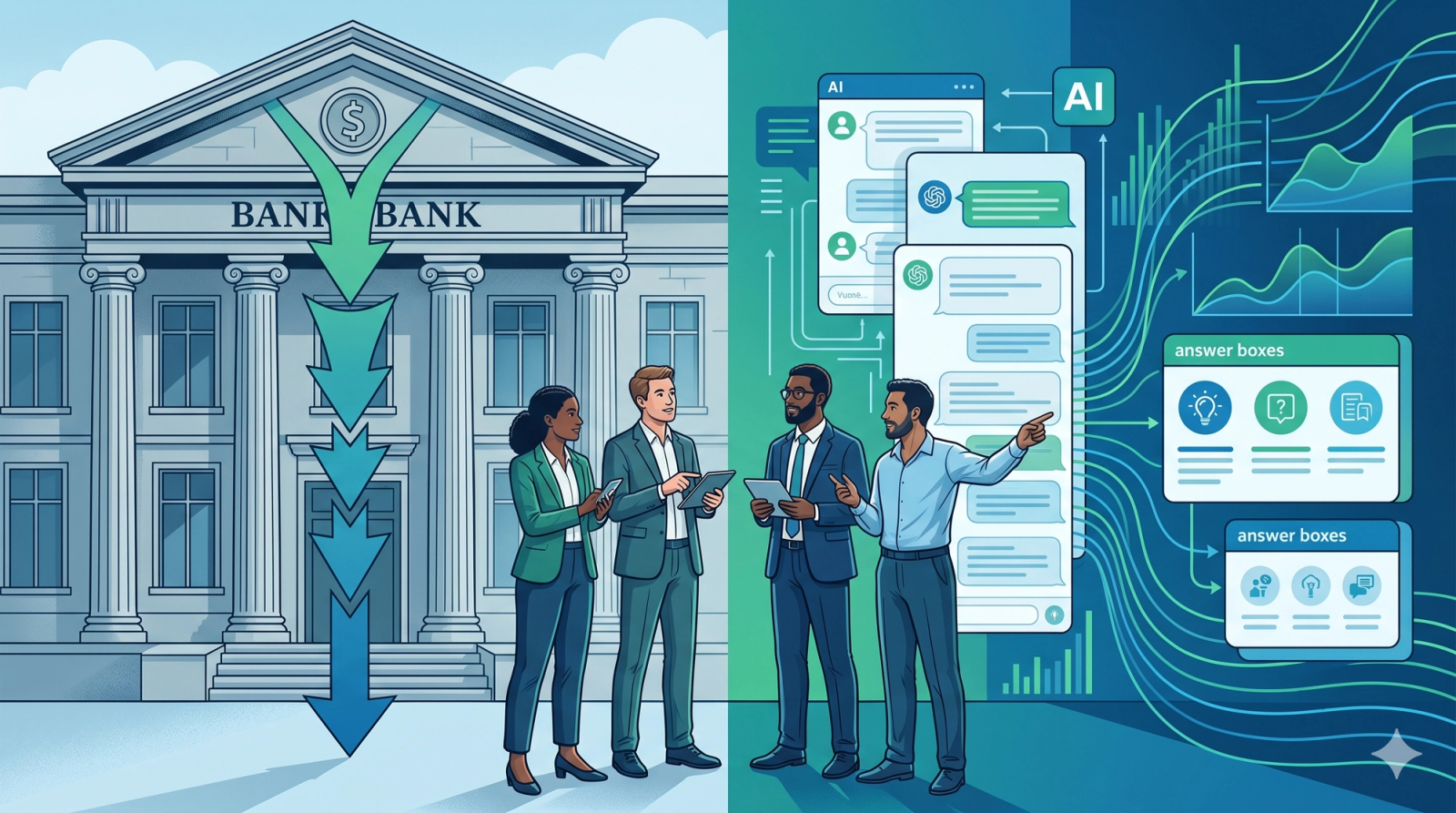
Your prospects no longer type a product name into Google, scan ten blue links, and click through to your landing page. A growing number start with a question typed into ChatGPT, Perplexity, or Google's AI Overviews – and the model answers directly, without a click required.
Gartner projects traditional search volumes will fall by more than 25% by 2028 as users shift to AI tools for direct answers. For financial services – where 72% of queries are informational – the impact is acute. A consumer asking "which savings account has the best rate right now" gets a synthesised answer. Your brand either appears in that answer or it doesn't.
Fintel Connect CEO Nicky Senyard, writing in late 2025, put it plainly: "Visibility is no longer solely about where you rank, but whether your product appears in large language models." In Fintel Connect's own research testing four major AI models, more than 60% of citations came from publishers and affiliate sites – not from the financial institutions themselves.
This is the core of what is now called Generative Engine Optimisation (GEO): the practice of ensuring your products and content appear in the information AI models draw from when constructing answers. Traditional SEO optimises for rank position. GEO optimises for inclusion in the answer itself.
The practical implication for FinServ marketers: the content ecosystem around your brand now matters as much as your own website. Third-party publishers, comparison sites, and affiliate partners shape whether AI models include your product in a synthesised answer. Click-funnel thinking – where the goal is to drive traffic to a landing page – misses the point of how discovery now works for a meaningful share of your potential customers.
What this means for strategy: Financial services marketers need to move beyond SEO as a channel and start thinking about answer-led visibility. That includes strengthening affiliate and publisher relationships, structuring product pages for machine-readability, and producing content formats – explainers, comparison tables, direct Q&A – that AI models can parse and cite.
Section 2: Attribution Breaks When AI Touches the Journey
The attribution problem that most FinServ marketing teams have not fully confronted: your last-click model is measuring the wrong thing.
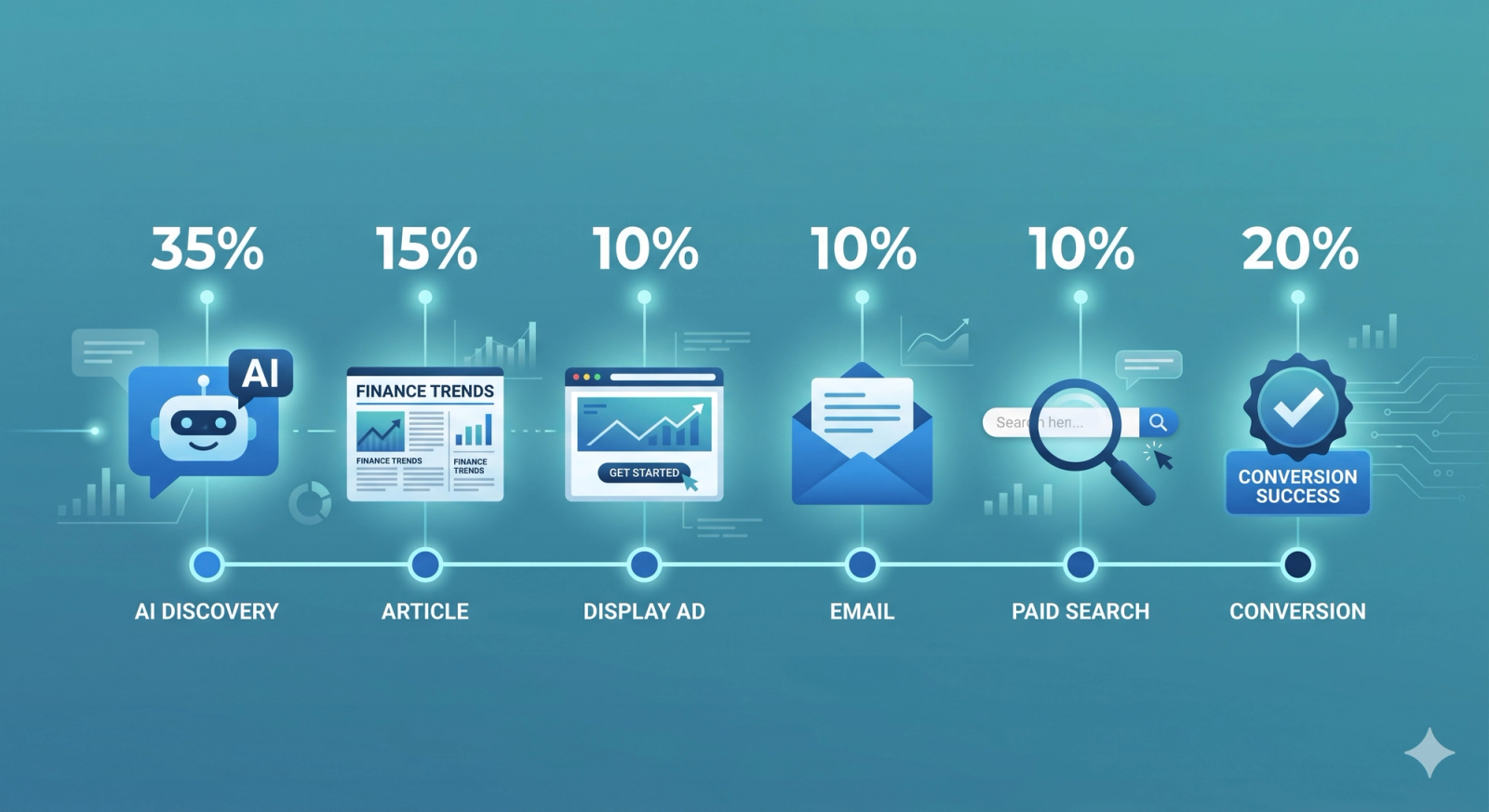
A consumer researching a mortgage product today might ask an AI tool for an overview, read a comparison article surfaced by that tool, see a retargeted display ad two days later, and then click a paid search result and convert. Last-click attribution credits the paid search click. The AI-influenced discovery steps – where most of the trust was built – receive zero credit.
This is not a minor accounting error. It systematically undervalues the channels and touchpoints that do the heavy persuasion work in long financial buying cycles. Teams optimise away from brand, content, and affiliate spend because the last-click model makes them look like poor performers. Budgets concentrate on bottom-funnel paid channels. The top and middle of the funnel atrophy. Acquisition costs rise.
According to Innovid's 2026 Financial Services Advertising Outlook, measurement and attribution is the highest-priority investment area for FinServ marketers, cited by 64% of respondents. The recognition that current measurement frameworks are inadequate is widespread. The response is still catching up.
The shift is toward outcome-based attribution – models that assign value across the full customer journey rather than awarding all credit to the final converting touchpoint. This requires unified data: first-party customer data connected to campaign data, connected to conversion data, across channels and over time. For most financial institutions, that data exists in fragments across disconnected systems.
Solving attribution in regulated financial services is not simply a technology problem. It requires data governance frameworks that satisfy compliance requirements while enabling cross-channel analysis. That intersection – analytical sophistication plus regulatory rigour – is where most generic marketing agencies fall short.
Section 3: Where FinServ Marketers Are Actually Using AI
Strip away the strategy decks and pilots, and where are FinServ marketing teams actually deploying AI today?
Innovid's 2026 Financial Services Advertising Outlook, which surveyed marketing leaders across the sector, shows a clear pattern:
Market research: 73% of FinServ marketers apply AI here – the most common use case by far
Creative development: 55% use AI in creative workflows
Copywriting: 45% apply AI to copy production
Data analysis: 45% and campaign optimisation: 36% are growing fast
The concentration in market research makes sense. AI tools excel at synthesising large volumes of qualitative and quantitative data – customer sentiment, competitor positioning, category trends – into structured insight at a fraction of the time manual analysis requires. A team that once spent three weeks on a quarterly competitive review can compress that to three days.
The creative and copywriting use cases are earlier in maturity but accelerating. AI-assisted production allows FinServ marketing teams to generate more asset variants, test more creative approaches, and adapt messaging by segment without proportionally increasing headcount or budget. For regulated brands managing lengthy approval cycles, the ability to produce compliant-ready copy at scale is a meaningful operational advantage.
What is largely absent from this list: full-funnel orchestration. AI is being applied to discrete tasks – a research workflow here, a creative brief there – but not to the connected, end-to-end marketing operation that links insight to execution to measurement. Most teams are using AI as a productivity tool in isolated functions rather than as a system that coordinates strategy, content, targeting, and attribution across the full customer lifecycle.
That gap has a name, and it has a cost.
Section 4: The Orchestration and Governance Gap
82% of FinServ marketers say orchestration is important. Most lack the systems to actually do it.
That finding from the same Innovid research captures the central tension in financial services AI marketing in 2026. The intent is there. The execution infrastructure is not.
The blockers are specific and well-documented:
Brand safety and compliance concerns: 55% – the top barrier to broader AI adoption
Integration challenges with existing tech stacks: 55% – equally significant
Governance concerns: 45% – including ethical considerations and model accountability
Data quality issues: 36% – garbage in, garbage out applies acutely in AI-assisted workflows
For financial services brands operating under FCA, SEC, FINRA, or equivalent regulatory frameworks, these are not abstract concerns. Every AI-generated piece of content, every programmatic targeting decision, every AI-assisted copy variant carries compliance exposure if the governance framework is not embedded from the start. A marketing claim that passes legal review in a templated approval process may not pass it when generated by a model at scale.
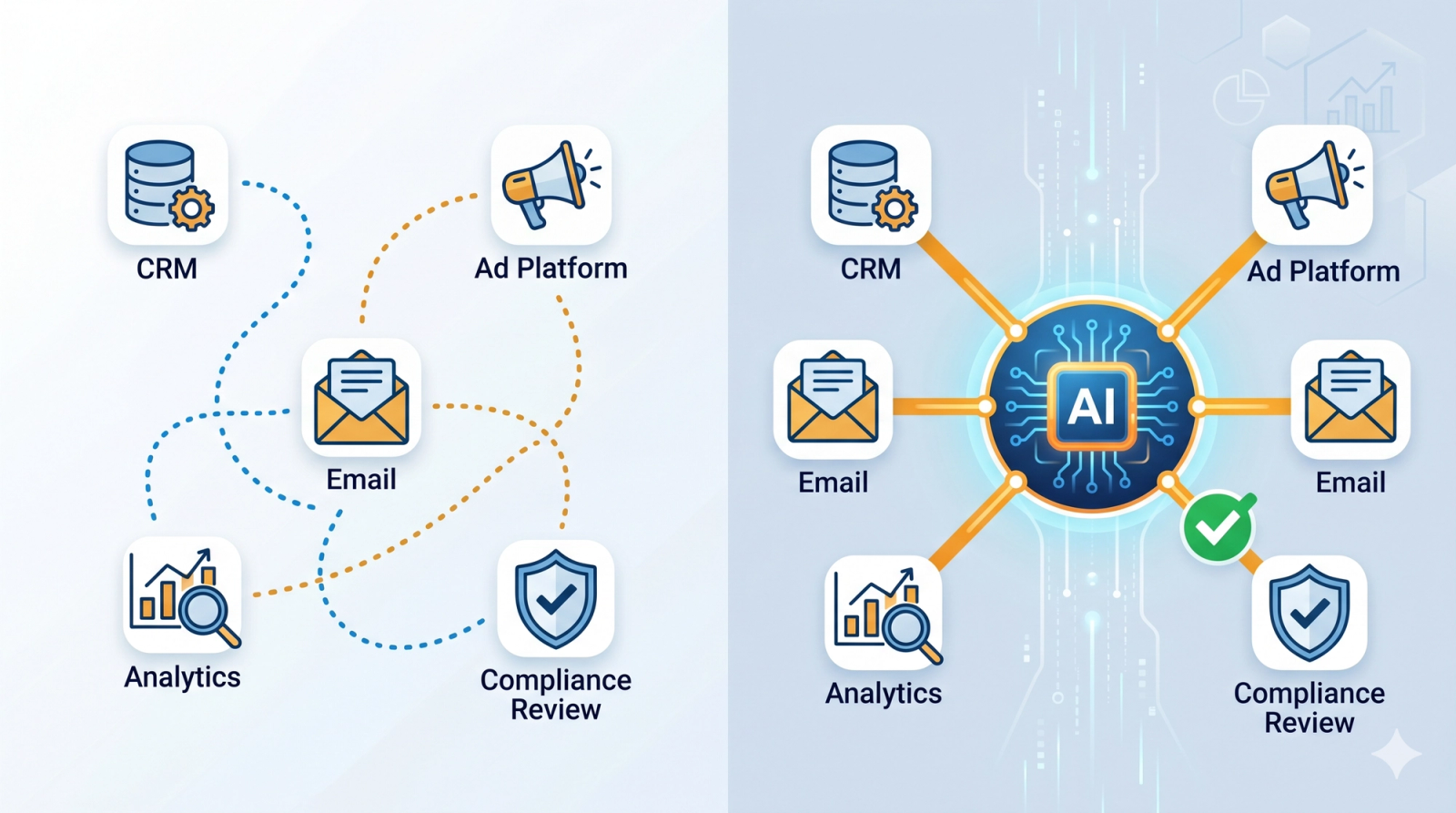
The problem compounds when organisations try to layer AI onto fragmented martech stacks without resolving the underlying data and integration issues first. Models trained on inconsistent or siloed data produce outputs that require extensive human correction – erasing most of the efficiency gains the AI was supposed to deliver.
The result: firms that invested in AI tooling without addressing orchestration and governance are sitting on technology they cannot fully use. They have the pilots. They do not have the system.
This is what Progrowth calls the orchestration gap – the distance between having AI tools and having AI-powered marketing that works at scale, within regulatory bounds, with measurable ROI attached. Closing it requires two things working together: compliant marketing execution and the AI-assisted infrastructure to coordinate it. Our AI marketing services for financial services are built specifically for regulated FinServ brands facing exactly this challenge.
Section 5: What Good Looks Like in 2026
The financial services firms seeing measurable gains from AI in marketing share a common architecture. It is not the most sophisticated model stack or the largest AI budget. It is a coherent system built on three foundations.
1. Embedded AI, not bolt-on AI.AI is part of how the marketing operation runs – in research workflows, content production, campaign optimisation, and attribution modelling – not a separate tool team members occasionally use. Campaigns move from insight to execution faster because AI assists human decision-making at each stage rather than sitting outside the process.
2. Governed data.First-party customer data is clean, unified, and connected across channels. Compliance requirements are built into data models and AI workflows, not checked at the end of a process. This is what allows AI to operate at scale in a regulated environment – not because the models are inherently compliant, but because the data and workflow architecture constrains them appropriately.
3. Measurable ROI tied to outcomes.Attribution models capture the full customer journey, including AI-influenced discovery touchpoints. Budget decisions are based on contribution to pipeline and revenue, not last-click proxy metrics. Marketing leadership can report confidently to the board on what the AI investment is returning and why.
This is not a 2027 aspiration. Firms operating this way are doing so now, and the competitive distance between them and the pilot-stage majority is widening. AI-assisted marketing automation built for the regulated FinServ context is available today – the constraint is not technology, it is prioritisation and the right execution partner.
For FinServ marketing leaders ready to move from isolated AI experiments to a system that drives pipeline: explore ProGrowth's AI marketing services.
Practical Adoption Checklist: Closing the Orchestration Gap
Use this checklist to assess where your organisation stands and where to prioritise:
Discovery and Visibility
Audit whether your brand appears in AI-generated answers for key product queries (ChatGPT, Perplexity, Google AI Overviews)
Identify your top three affiliate and publisher partners; confirm they have current, accurate product data
Restructure at least one core product page for machine-readability: plain language, direct Q&A, comparison tables
Attribution and Measurement
Map your current attribution model; identify the first-party data gaps preventing full-journey measurement
Define three outcome-based KPIs that capture value across the full funnel, not just conversion
Audit your martech stack for integration gaps blocking unified data access
AI Workflow Integration
Document current AI use cases by function (research, creative, copy, optimisation)
Identify one high-volume, repetitive workflow to automate with AI this quarter
Establish a compliance review process designed for AI-generated content at scale
Governance and Compliance
Confirm you have a documented AI content governance framework reviewed by legal and compliance
Assign clear accountability for AI-generated content sign-off
Establish a regular audit cycle for AI model outputs against brand and regulatory standards
Orchestration
Identify whether strategy, execution, and measurement are connected or siloed in your current setup
Evaluate whether your current agency or technology partner can close the orchestration gap or is contributing to it
Work With a Partner That Closes the Gap, Not One That Widens It
Most agencies offer AI tooling. Few understand what it takes to deploy it inside a regulated financial services marketing operation – where brand safety is a legal requirement, where every claim carries compliance exposure, and where measurable ROI is expected from the first 90 days.
ProGrowth is a fractional CMO service with AI-assisted execution built exclusively for B2B companies in regulated sectors, including financial services, fintech, and commercial banking. We do not apply consumer marketing playbooks to FinServ sales cycles. We combine compliance-first execution with AI-assisted workflows that produce measurable pipeline outcomes at mid-market economics.
Ready to close your orchestration gap?
Explore our AI marketing services →See how we work with FinTech and financial services brands →Learn how AI automation fits your marketing operation →
Never Miss Our Latest Insights
Get exclusive B2B marketing strategies, AI automation tips, and growth tactics delivered straight to your inbox every week.
We respect your privacy. Unsubscribe at any time.