

How to Hire a Fractional CMO for a B2B Company
By Siva Cotipalli · Published
Step-by-step guide to hiring a fractional CMO for B2B. Define scope, source candidates, ask the right questions, and design contracts that deliver results.
Siva Cotipalli
August 12, 2026
You need marketing leadership, not another consultant

You have concluded you need fractional marketing leadership. Your marketing team lacks strategic direction, your pipeline is inconsistent, or you are preparing to scale and cannot justify a full-time CMO. The decision is made. Now you must execute the hire without wasting months on the wrong person.
A bad fractional CMO hire costs more than their fee. You lose momentum, your team executes flawed strategy, and your competitors gain ground while you recover. This guide walks you through the hiring process: defining scope before you search, sourcing candidates who can execute rather than advise, interviewing to reveal strategic capability, and designing contracts that set both parties up to deliver results quickly.
Define scope and expectations before you search
Most hiring failures begin before the first interview. You start searching without defining what success looks like. A fractional CMO can audit your function, provide maternity cover, lead a website migration, support an under-experienced marketing leader, transform operations, or prepare the business for acquisition. Each requires different skills and different time commitments.
Write down what you need this person to accomplish in the first 90 days. Be specific. 'Improve marketing' is not a scope. 'Audit lead generation, identify why conversion dropped last quarter, and implement fixes' is a scope. The clearer your definition, the easier it becomes to evaluate whether a candidate can deliver it.
Consider your existing team. A fractional CMO works with your people, not instead of them. If you have a junior team, you need someone who can mentor while executing. If you have specialists who lack coordination, you need someone who can orchestrate without micromanaging. If you have no team, you need someone with a network of trusted execution partners they can bring in.
Document your budget, your timeline, and your internal capacity to support the engagement. A fractional CMO costs less than a full-time hire, but they still require your time to onboard, your data to analyze, and your team to execute.
Source candidates through referrals, networks, and platforms

The best fractional CMOs rarely advertise. They work through referrals and professional networks. Start by asking peer founders, your board, or your investors whether they have worked with a fractional marketing leader they would hire again. A referral from someone who has seen the work carries more weight than any LinkedIn profile.
Look at industry-specific communities. B2B SaaS fractional CMOs often participate in marketing forums, write on Medium, or speak at conferences. If they have domain expertise in your sector, they should have a visible footprint in that sector's conversations.
Platforms exist, but treat them as one channel among several. Some fractional CMO providers operate as agencies that match you with an executive from their roster. Others are solo practitioners who list on marketplaces. Agency models give you support and methodology; solo practitioners give you undivided attention and often lower cost. Neither is inherently better. What matters is whether the specific person can solve your specific problem.
When evaluating online presence, apply the same standard you would apply to your own marketing team. For someone working in marketing, a weak digital footprint raises questions. Have they published long-form content? Are they active on LinkedIn? Have they appeared on podcasts or at events? Do they have a website showcasing their work? Established fractional CMOs should have testimonials and logos of companies they have worked with.
Interview to reveal strategic capability versus executional consulting

The interview separates strategic leaders from tactical consultants. You are not hiring someone to run Google Ads or write blog posts. You are hiring someone to set direction, align your team, and make marketing a predictable growth driver. Your questions must test for that capability.
Ask them to describe a time they inherited a broken marketing function. What did they diagnose first? What did they fix first? What did they decide not to fix? The answer reveals how they prioritize, whether they can separate signal from noise, and whether they understand that strategy is as much about what you stop doing as what you start.
Present a simplified version of your current situation and ask how they would approach the first 60 days. A strong candidate will ask clarifying questions before answering. They will want to know your revenue model, your sales cycle, your customer acquisition cost, and whether your pipeline problem is volume or quality. If they offer a generic playbook without asking those questions, they are not thinking strategically.
Test their ability to work with your existing team and leadership. Ask how they handle a situation where the founder disagrees with their recommendation. Ask how they would collaborate with a sales leader who believes marketing does not generate real pipeline. Ask how they mentor a junior marketer who is overwhelmed. You need someone who can build trust with your C-suite, manage expectations, and elevate marketing as a strategic partner in the business.
An experienced freelancer will likely have a network of contacts for specialized tasks like paid acquisition, copywriting, website development, SEO, and branding. If they offer to do all of those tasks themselves, walk away. A CMO is a generalist who orchestrates specialists, not someone who plays every instrument.
Ask about their approach to measurement. How do they define success in a fractional engagement? What metrics do they track in the first 90 days? How do they report progress to leadership? If they talk only about vanity metrics, they do not understand B2B pipeline dynamics.
Red flags that should end the conversation
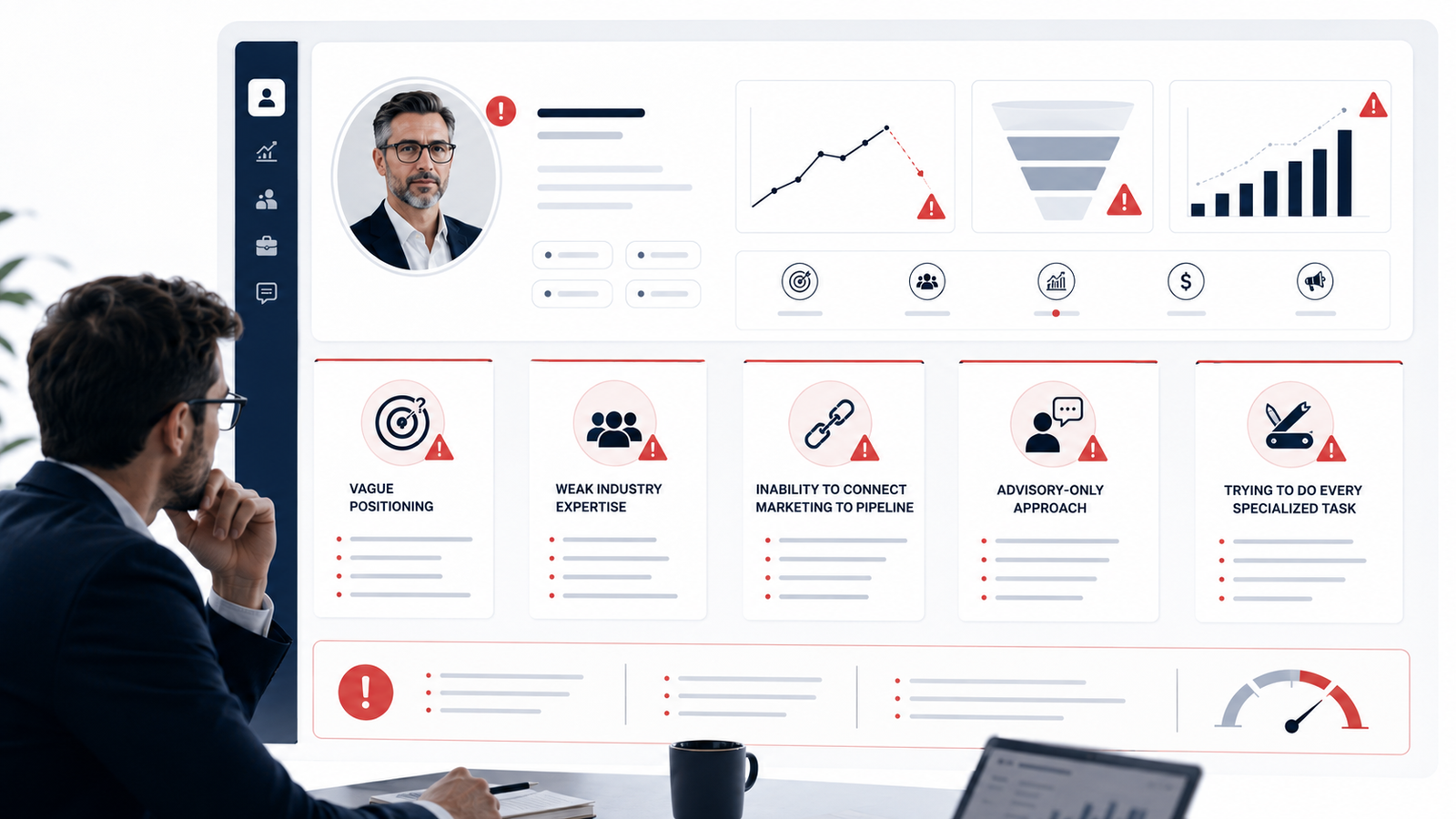
Some warning signs indicate a candidate will not deliver results. Vague positioning is the first. If they describe themselves as helping 'businesses grow' or 'companies succeed', they have not defined a clear ICP for their own services. A marketer who cannot position themselves cannot position your company.
No ICP discipline is the second. If they work with e-commerce startups one month and manufacturing firms the next, they lack the depth you need. B2B SaaS marketing is different from retail marketing. Financial services marketing operates under different constraints than tech. You want someone who has solved problems in contexts similar to yours.
Inability to tie marketing to pipeline is the third. If they cannot explain how their last engagement moved the needle on qualified leads, pipeline value, or revenue, they were either not measuring correctly or not delivering results. Either disqualifies them.
Many fractional CMO providers offer strategic guidance from an outside advisory role. Others provide part-time CMO leadership with full accountability. If they propose monthly strategy sessions but no hands-on work between meetings, you are hiring the wrong model. You need execution and accountability, not slide decks.
Be cautious of anyone who offers to do specialized tasks that belong to vendors or agencies. A fractional CMO who says they will personally manage your paid acquisition, write all your content, and redesign your website is either inexperienced or dishonest.
Design contracts and engagement structures that enable fast results
Contract design determines whether the engagement delivers value quickly or drifts into advisory limbo. A fractional CMO should offer flexible terms with no long-term commitments unless you specifically need the assurance of continuity. Contracts should allow either party to exit with reasonable notice.
Define time commitment in hours per week or days per month, not vague part-time language. Fractional CMOs are consistently available a certain number of hours each week for long-term engagements. Less than that and they cannot maintain momentum. More than that and you approach the cost of a full-time hire without the full-time benefit.
Establish clear deliverables tied to your goals. The first few months should produce an audit, a revised strategy, and at least one implemented improvement that moves a measurable metric.
Build in checkpoints. Schedule a review at the first month to assess fit and progress. Not every match works, and discovering that early is better than discovering it months later. The review should cover whether they have integrated with your team, whether they have identified the right priorities, and whether early indicators suggest progress.
Clarify decision rights and reporting structure. Who does the fractional CMO report to? What decisions can they make independently, and what requires approval? How often do they meet with leadership? Ambiguity here creates friction that slows execution.
Set up onboarding that accelerates time to value
Onboarding determines how quickly your fractional CMO can deliver results. Most fractional engagements waste the first month because the new leader spends it hunting for information that should have been prepared in advance.
Before their start date, compile a briefing package. Include your current marketing plan if one exists, your customer personas or ICP definition, your sales process and typical deal cycle, your revenue and pipeline data for the last year, and access to your marketing technology stack. Add context on recent campaigns, what worked, and what did not.
Schedule introductions with everyone they will work with regularly: your sales leader, your product lead, and key members of your marketing team. Include any external agencies or vendors currently under contract. Block time for these in advance rather than trying to coordinate them as you go.
Give them access to the systems and data they need on day one. That includes your CRM, your marketing automation platform, your analytics, and any project management or communication tools your team uses. Waiting weeks for IT to provision accounts wastes their time and your money.
Set clear expectations for the first month. Most fractional CMOs will spend the first two weeks in discovery: interviewing stakeholders, auditing current activities, analyzing data, and identifying gaps. By the end of the first month, they should present findings and a prioritized action plan. Agree on this timeline upfront so both parties know what success looks like.
Establish a regular communication cadence. Weekly check-ins with the executive team and daily or near-daily availability for the marketing team create the rhythm needed to maintain momentum without overcommunicating.
Use an evaluation scorecard to compare candidates objectively
When you interview multiple candidates, subjective impressions blur together. A scorecard keeps you honest. Rate each candidate on the criteria that matter most to your engagement.
Domain expertise: Do they have deep experience in your industry or business model? When narrowing your search, align on filters including local knowledge, team size and seniority, fundraising stage, budget, and industry sector. A fractional CMO with B2B SaaS experience understands product-led growth and enterprise sales cycles. One without that background will spend your budget learning what they should already know.
Strategic capability: Can they diagnose root causes rather than symptoms? Can they prioritize ruthlessly? Can they articulate a clear theory of how marketing should drive pipeline in your context?
Execution track record: Have they delivered measurable results in previous fractional engagements? Can they provide references who will confirm those results?
Team leadership: Can they mentor junior team members, coordinate specialists, and earn the trust of your C-suite?
Cultural fit: Do they communicate in a way that matches your company's operating style? Can they challenge your assumptions without creating conflict?
Network and resources: Can they bring in trusted specialists when needed? Do they have relationships with vendors or agencies that could accelerate your work?
Score each candidate on a simple scale: does not meet expectations, meets expectations, exceeds expectations. Use the scorecard to structure your debrief conversation with other stakeholders. It prevents the loudest voice in the room from overriding a more balanced assessment.
Sample interview questions that separate strategy from consulting
Your interview questions should test for the capabilities outlined in your scope. These examples reveal how a candidate thinks and works.
'Walk me through how you would diagnose why our pipeline dropped last quarter.' Listen for whether they ask clarifying questions, whether they consider multiple hypotheses, and whether they can distinguish between data they would need immediately versus data they would gather over time.
'Describe a time you had to tell a founder their positioning was wrong. How did you approach that conversation?' This tests whether they can deliver hard feedback constructively and whether they understand that strategy sometimes requires saying no.
'How do you decide what marketing activities to stop?' You are testing for prioritization discipline and whether they understand opportunity cost.
'What metrics would you track in the first months of this engagement, and why?' You want to see whether they focus on leading indicators of pipeline health or lagging indicators like revenue that take too long to move in a short engagement.
'Tell me about a fractional engagement that did not go well. What went wrong, and what did you learn?' Everyone has had a bad engagement. How they talk about it tells you whether they take responsibility and adapt or blame the client.
'If I called your last three clients, what would they say you are exceptional at, and what would they say you could improve?' This is a reference check question disguised as a self-assessment question. If their answer is all strengths and no weaknesses, they are not self-aware.
What happens in the first months of a successful engagement
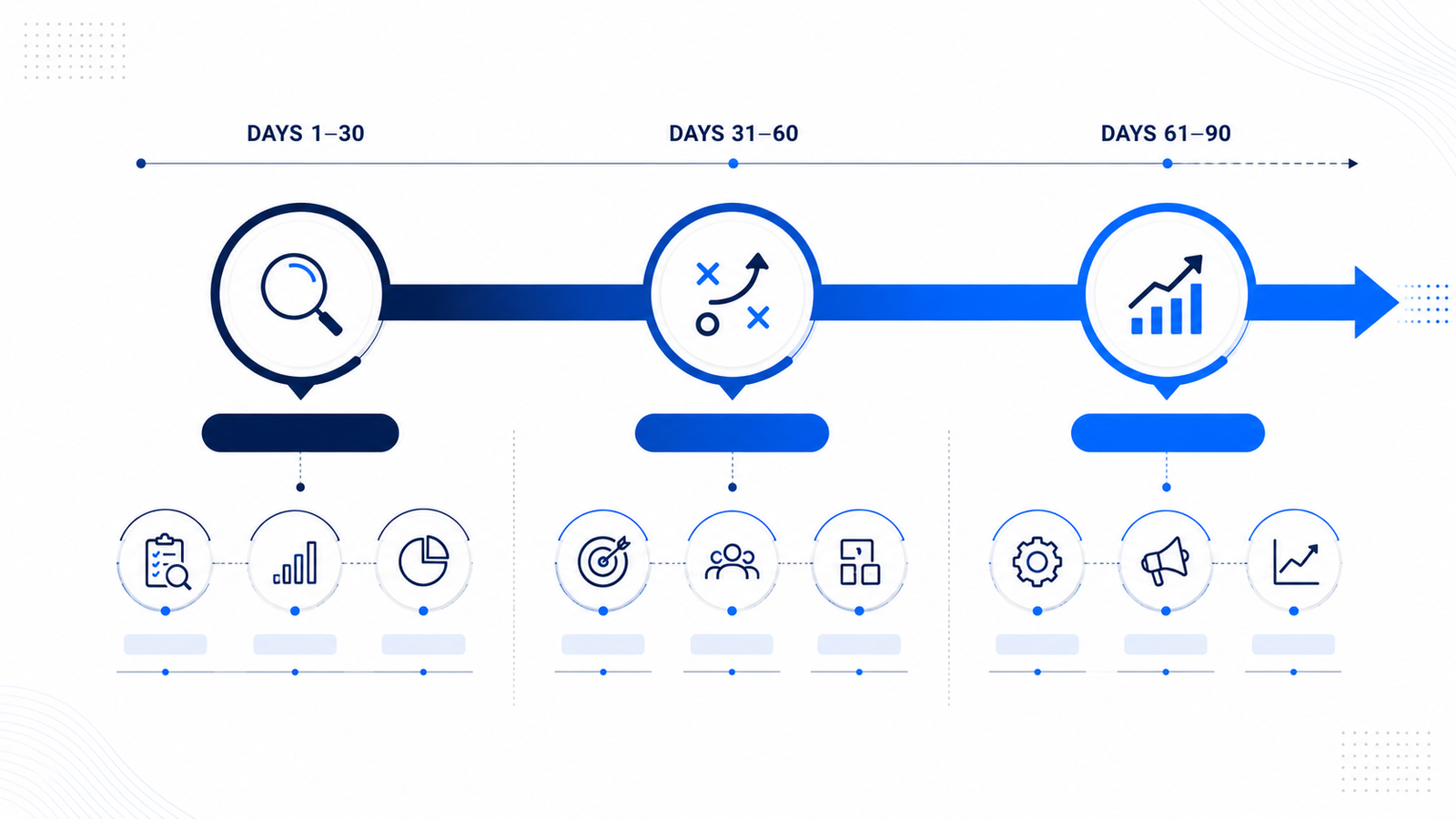
The first months set the trajectory for the entire engagement. A well-structured fractional CMO engagement moves through three phases in that window.
First month: Discovery and diagnosis. The fractional CMO interviews stakeholders, audits existing marketing activities, analyzes pipeline and conversion data, and identifies the gaps between where you are and where you need to be. By the end of this phase, they should present a findings document that explains what is working, what is broken, and what is missing.
Second month: Strategy and prioritization. Based on the diagnosis, the fractional CMO develops a marketing strategy that aligns with your business goals. This is not a lengthy deck. It is a clear articulation of your ICP, your positioning, your offers, and the initiatives that will move the needle in the next months. They also identify any team gaps, process gaps, or technology gaps that must be addressed.
Third month: Implementation and early wins. The fractional CMO begins executing the highest-priority initiatives. This might mean launching a new lead nurture sequence, refining your sales enablement materials, or fixing a broken conversion step in your funnel. The goal is not to complete the entire strategy. The goal is to demonstrate measurable progress on at least one metric that matters: lead volume, lead quality, pipeline value, or conversion rate.
After the initial period, both parties should review results and decide whether to continue, adjust scope, or part ways. A successful engagement will show clear evidence that the fractional CMO has identified the right problems and begun solving them.
How ProGrowth structures fractional CMO engagements differently
ProGrowth combines fractional CMO-level strategy with AI-native execution, delivered as one engine rather than separate vendor tracks. That means the same team that sets your strategy also builds the workflows and agents that let a lean team execute at scale.
ProGrowth avoids the advisory-only model that leaves you with a deck and no execution. ProGrowth puts the figure at 50 to 75 percent less cost than a full-time hire.
Because the work is AI-native, the same team builds the systems that make your marketing more efficient over time. That includes lead routing, nurture workflows, and content production cycles that do not require bloated headcount to scale. You get strategy, execution, and the infrastructure to sustain growth after the engagement ends.
For more on how fractional CMO services drive measurable revenue growth, see how a fractional CMO can boost small business revenue.
When hiring a fractional CMO is the wrong move
Not every company should hire a fractional CMO. If your revenue is below the threshold where you have paying customers and a defined sales process, you likely do not have the budget or the operational maturity to support this model. A fractional CMO requires a certain baseline: an existing product with paying customers, a defined sales process, and enough marketing activity that strategy can unlock leverage. Without those, you are better served by a marketing generalist or an agency that can handle both strategy and execution.
If you are looking for someone to execute tasks rather than set direction, hire a contractor or an agency, not a fractional CMO. The value of a fractional CMO is strategic leadership. If you already have a clear strategy and you just need hands on keyboards, you are overpaying for a skill set you do not need.
If your executive team is not aligned on growth priorities, a fractional CMO cannot fix that. They can advise and facilitate, but if your founder and your sales leader fundamentally disagree about target market or pricing strategy, the fractional CMO will spend their time mediating rather than executing. Resolve those disagreements before you bring in outside leadership.
Your next step
You now have a framework for hiring a fractional CMO: define scope before you search, source through referrals and networks, interview to reveal strategic capability, flag the warning signs that indicate a bad fit, design contracts that enable fast results, and structure onboarding so your new leader can deliver value quickly.
The hiring process is not the hard part. The hard part is being honest about what you need and whether you are ready to act on the insights a good fractional CMO will surface. Start by writing down the specific problem you need this person to solve. Then use that definition to evaluate every candidate, every conversation, and every contract term.
Frequently Asked Questions
- What is the typical cost of hiring a fractional CMO for a B2B company?
- Full-time CMOs often cost over $300,000 annually. A fractional CMO provides the same expertise on a flexible basis, making it accessible to businesses that need leadership but do not have the budget for a full-time executive.
- How long should a fractional CMO engagement last?
- Fractional CMOs are consistently available for a certain number of hours each week for long-term engagements. Most engagements run longer periods. The first months focus on discovery, strategy, and early implementation. After the initial period, both parties review results and decide whether to continue, adjust scope, or part ways.
- What is the difference between a fractional CMO and a marketing consultant?
- Many fractional CMO providers offer strategic guidance from an outside advisory role. Others provide part-time CMO leadership with full accountability, embedding within your organization to deliver strategy and execution. Marketing consultants typically advise without hands-on execution. Fractional CMOs actively integrate into your company's operations.
- What red flags should I watch for when interviewing fractional CMO candidates?
- Warning signs include vague positioning, no ICP discipline, inability to tie marketing to pipeline, consultants who only advise without hands-on execution, and candidates who offer to personally perform specialized tasks like paid acquisition or website development that should be handled by vendors or agencies.
Never Miss Our Latest Insights
Get exclusive B2B marketing strategies, AI automation tips, and growth tactics delivered straight to your inbox every week.
We respect your privacy. Unsubscribe at any time.