

Is AI Marketing Automation Worth It for a 20-Person Company
By Siva Cotipalli · Published
Three questions decide the ROI: repeatable offers, defined ICP, and enough pipeline volume. Compare costs against headcount and agency alternatives.
Siva Cotipalli
August 10, 2026
TL;DR: The honest threshold first
AI marketing automation is worth it for a 20-person company when three conditions hold: you have repeatable offers that convert at a known rate, a defined ICP you can describe in two sentences, and enough monthly deal flow to justify the system overhead.
If your pipeline is inconsistent or your ideal customer profile remains unclear, automation amplifies the wrong work.
AI marketing automation typically costs under $2,000 per month. A single marketing hire can cost between $5,000 and $8,000 per month plus benefits, recruiting fees, and equipment.
When the fundamentals are in place, automation delivers measurable results quickly. When the fundamentals are not in place, automation scales the problem rather than the solution.
Three questions that determine ROI
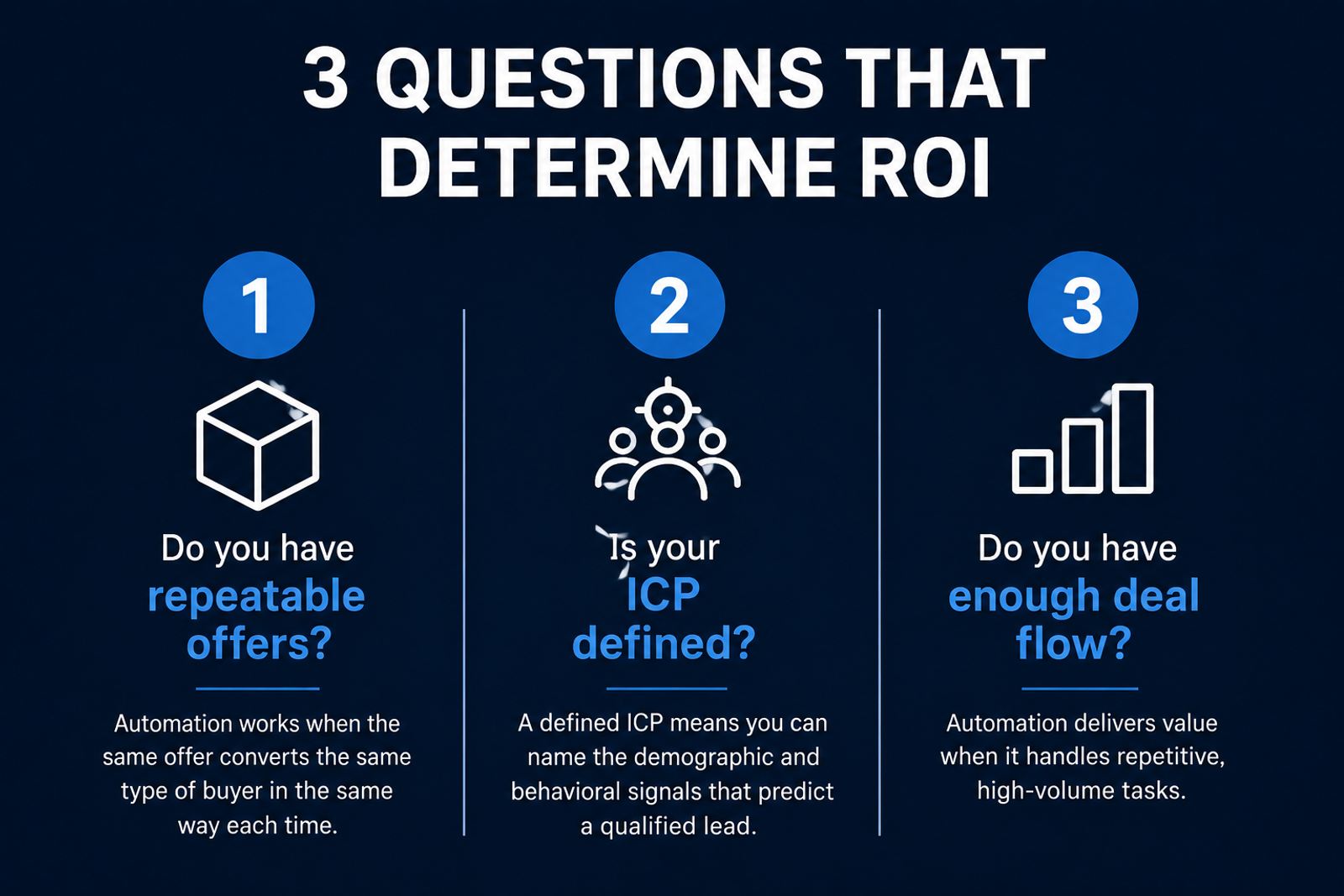
Do you have repeatable offers?
Automation works when the same offer converts the same type of buyer in the same way each time. If every deal is bespoke or your messaging is still being figured out, automation will not fix that.
A repeatable offer means you know which problem you solve, for whom, and at what price. You can describe the buyer journey from first touch to close in under five steps.
Is your ICP defined?
A defined ICP means you can name the demographic and behavioral signals that predict a qualified lead. Revenue band, industry, role, and one or two intent signals.
Marketing automation platforms use a lot of customer data, which means they collect, organize, and unify customer data as well. If you do not yet know who converts, the system will collect data on everyone and convert no one faster.
Do you have enough deal flow?
Automation delivers value when it handles repetitive, high-volume tasks. Most small-business automation tools run $50 to $500 per month depending on list size and features.
If you are sending fewer than 500 emails monthly or managing under 100 leads, basic automation or manual processes will suffice at that scale. The ROI calculation becomes favorable when labor costs exceed tool costs by three times or more.
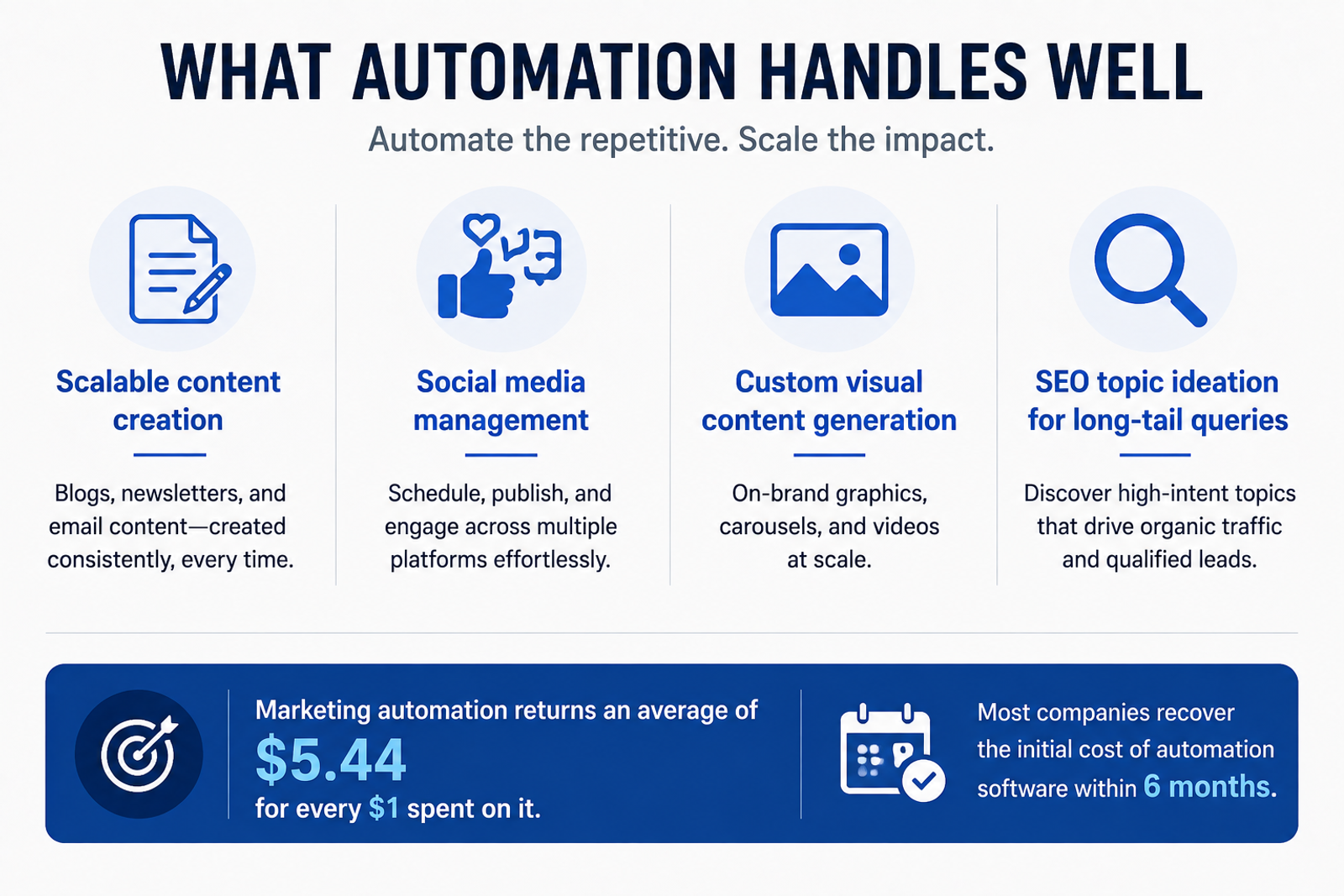
Marketing automation returns an average of $5.44 for every dollar spent on it. Most companies recover the initial cost of automation software within six months.
Cost comparison: automation versus headcount versus agency
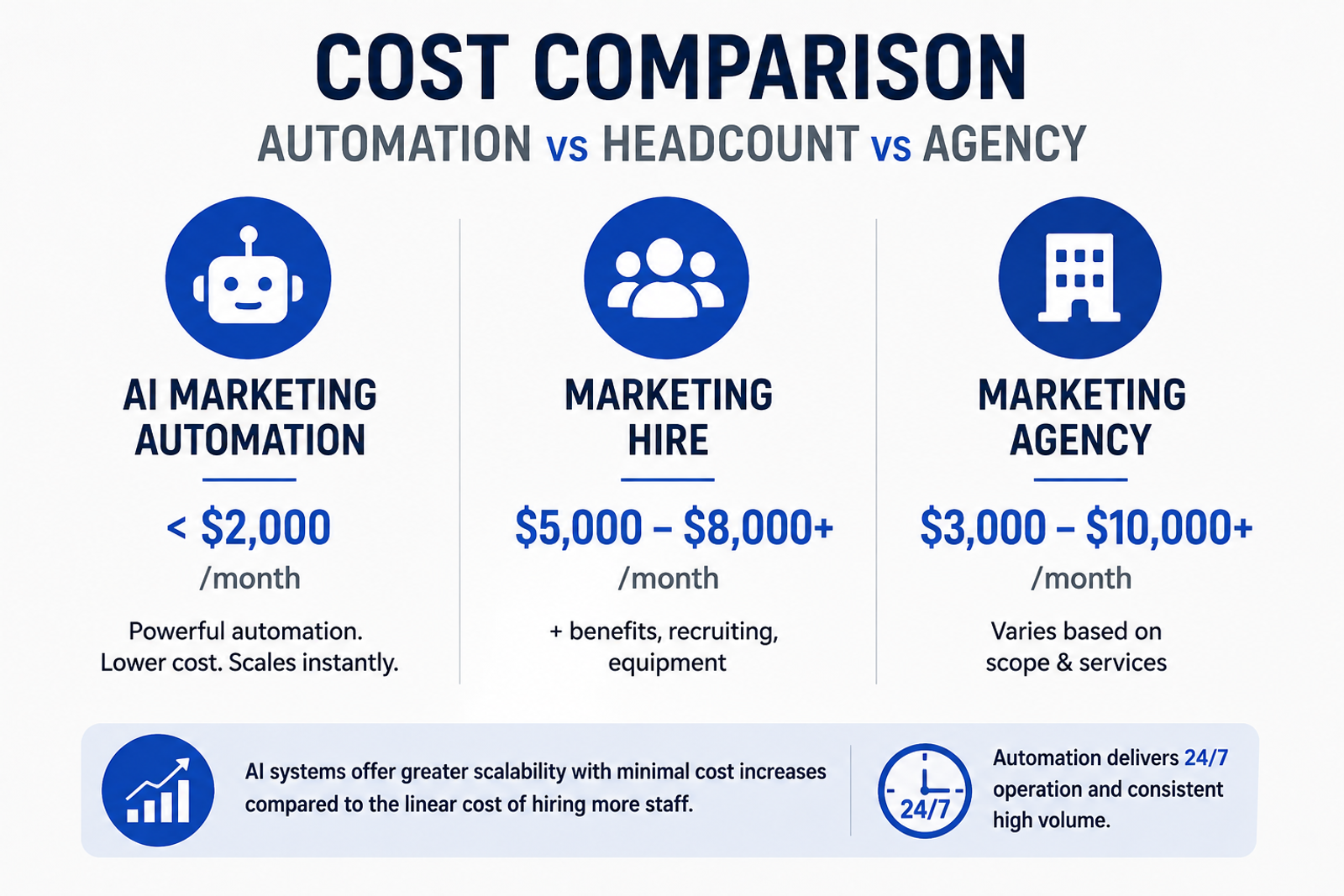
AI marketing automation typically costs under $2,000 per month. Hiring a single marketing employee can cost between $5,000 and $8,000 per month plus benefits.
A mid-level marketing manager in the US earns $55,000 to $85,000 per year. That figure does not include recruiting fees, equipment, or ongoing professional development costs.
AI systems offer greater scalability with minimal cost increases compared to the linear cost of hiring more staff. Automation delivers 24/7 operation and consistent high volume, while human output is limited to standard work hours.
ProGrowth positions a fractional CMO backed by AI-native execution as an alternative to both full-time hires and traditional agencies, delivering strategy and hands-on execution without hiring a full department.
The most impactful tasks to automate are repetitive, time-consuming, and data-driven. Four key areas stand out: scalable content creation for blogs and newsletters, social media management across multiple platforms, custom visual content generation, and SEO topic ideation to address long-tail search queries.
What automation handles well and where it falls short
Automation does not forget to follow up. Your lead nurture sequence runs on a Saturday night the same as a Tuesday morning.
AI can optimize for the goal you set, but it cannot figure out whether that is the right goal. If your messaging is off, automation scales the problem rather than solving it.
Original ideas, compelling storytelling, and consistent brand voice are areas where skilled marketers still outperform AI tools by a meaningful margin. AI-generated content tends toward the generic.
Long-term clients, referral partnerships, and speaking opportunities come from real human relationships. There is no email sequence that builds genuine trust the way a person can.
Businesses using marketing automation report an average 20% increase in sales opportunities. That figure only holds when the automation is set up thoughtfully, not just turned on.
Getting automation to work well takes time upfront, often weeks of mapping workflows, writing copy, and testing before results become reliable.
Generic tools versus integrated systems
Platforms like HubSpot, Mailchimp, Klaviyo, and ActiveCampaign are the most common tools small businesses use to get automation running. These tools handle email marketing, landing pages and forms, campaign management, lead nurturing and scoring, and CRM integration.
Marketing automation software streamlines, automates, and measures the results of marketing tasks and workflows. It enables lead generation, segmentation, relationship marketing, and marketing ROI measurement.
An integrated system connects every lead source, scrubs and standardizes data at entry, and reports revenue back to advertising platforms. You can see which clicks turned into revenue.
67% of small teams abandon tools within 90 days due to integration failures, not feature limitations. Native integrations work when you need real-time, two-way sync. Zapier works when you need multi-step logic, field transformations, or filtering.
The most effective approach is a hybrid model that combines human talent and AI. Humans are responsible for high-level strategy, creative vision, and building customer relationships. AI systems handle the repetitive execution of tasks at scale.
How to size the decision: a volume and signal test
Your monthly email sends matter. If you are running fewer than 500 outbound emails per month, the overhead of setting up sequences and testing variants will exceed the labor you save.
Your lead volume matters. Managing under 100 leads per month by hand is still faster than configuring workflows, writing nurture copy, and troubleshooting integrations.
Your conversion clarity matters. If you cannot name the three to five touches that move a lead from inquiry to close, automation cannot build what you have not yet mapped.
Your team capacity matters. Getting automation to work well takes time upfront, often weeks of mapping workflows, writing copy, and testing before results become reliable. Someone on your team must own that setup work.
Automation makes sense when you are spending ten or more hours weekly on email scheduling, social media posting, or lead qualification. Below that threshold, the setup cost exceeds the return.
Your deal consistency matters. If every engagement requires custom scoping, pricing varies widely, or your product mix changes month to month, automation will not create the repeatability you need.
Your attribution clarity matters. When you cannot trace which marketing activities produce which opportunities, automation will run smoothly but you will not know whether it is working. You need baseline conversion data before the system can optimize.
A go/no-go decision tree
Go if:
You are sending more than 500 emails per month or managing over 100 leads.
Your conversion rate is known and consistent across at least ten closed deals.
You can name your ICP in two sentences and your team agrees on the definition.
You are spending ten or more hours weekly on email scheduling, social media posting, or lead qualification.
Your current marketing labor costs exceed tool costs by three times or more.
No-go if:
Every deal is bespoke and your offer changes deal to deal.
You do not yet know which messaging converts or which channels drive qualified pipeline.
Your lead volume is under 100 per month.
You lack the internal capacity to map workflows, write copy, and test for the first 30 to 60 days.
Your firm is below revenue thresholds where marketing is still mostly founder-led.
Wait and build the foundation if:
Your ICP is defined but your messaging is still being tested.
You have repeatable offers but deal flow is inconsistent.
You know automation will help but no one on the team has the bandwidth to implement it.
In that case, a fractional CMO engagement sets the strategy, defines the ICP, and builds the workflows before automation goes live.
What to measure once automation is live
Track hours spent on email campaigns weekly. Target a 40-60% reduction from your manual baseline.
Cost per lead should drop 20-30% within the first 90 days. Email-to-conversion rate should improve 15-25%.
Campaign creation time should fall by 50-70%. Lead response time should drop by 80-90%.
Payback periods average 6-8 weeks. 89% of businesses achieve positive ROI within the first quarter when replacing manual workflows.
If those metrics are not moving after 60 days, the issue is not the tool. It is strategy, ICP definition, or workflow design.
When sequence speed matters more than volume
Automation shines when timing drives conversion. A fast, friendly SMS plus a concise email meets every inquiry within seconds, while competitors are still refreshing their inbox.
Automation does not forget to follow up. Your lead nurture sequence runs on a Saturday night the same as a Tuesday morning.
A brief, logic-based survey or form gates your calendar and disqualifies poor fits before anyone books. Direct qualified users to book; cordially route mismatches to resources or lower-tier options.
Re-engagement and long-term nurture warm up leads who did not book and prospects who said 'not yet', without clogging sales calendars. Value-first follow-up reactivates without spamming.
When to bring in outside help
ProGrowth deploys AI automation marketing systems for B2B firms in professional services, tech, and financial services. The work combines fractional CMO strategy with hands-on execution, without hiring a full department.
Engagements begin with three questions: do you have repeatable offers, a defined buyer, and enough deal flow to justify the system? If the answer to any of those is no, the first 30 days build the foundation rather than the automation.
Once the strategy is set, the system connects lead sources, standardizes data, routes qualified leads, and reports closed revenue back to advertising platforms.
The honest answer for smaller firms: a system like this is usually premature. Build the repeatable offer and the defined ICP first.
Frequently Asked Questions
- How much does AI marketing automation cost compared to hiring a marketing employee?
- AI marketing automation typically costs under $2,000 per month. Hiring a single marketing employee can cost between $5,000 and $8,000 per month plus benefits, recruiting fees, and equipment. AI systems also offer greater scalability with minimal cost increases compared to the linear cost of hiring more staff.
- What marketing tasks should a 20-person company automate first?
- The most impactful tasks to automate are repetitive, time-consuming, and data-driven. Four key areas stand out: scalable content creation for blogs and newsletters, social media management across multiple platforms, custom visual content generation, and SEO topic ideation to address long-tail search queries.
- What is the typical ROI and payback period for marketing automation?
- Marketing automation returns an average of $5.44 for every dollar spent on it. Most companies recover the initial cost of automation software within six months. Payback periods average 6-8 weeks, and 89% of businesses achieve positive ROI within the first quarter when replacing manual workflows.
- Does AI marketing automation replace the need for a human marketing team?
- No, the most effective approach is a hybrid model that combines human talent and AI. In this model, humans are responsible for high-level strategy, creative vision, and building customer relationships. AI systems handle the repetitive execution of tasks at scale, allowing a smaller, more strategic human team to achieve a much larger impact.
- When should a 20-person company avoid implementing marketing automation?
- Avoid automation if every deal is bespoke and your offer changes deal to deal, if you do not yet know which messaging converts or which channels drive qualified pipeline, if your lead volume is under 100 per month, if you lack the internal capacity to map workflows and test for the first 30 to 60 days, or if your firm is at a stage where marketing is still mostly founder-led.
Never Miss Our Latest Insights
Get exclusive B2B marketing strategies, AI automation tips, and growth tactics delivered straight to your inbox every week.
We respect your privacy. Unsubscribe at any time.