

Lead Generation Strategies for Financial Services Companies
By ProGrowth Team · Published
Financial services CAC rose 40–60% since 2023. Learn 7 proven lead generation strategies for banks, fintechs, and advisors to lower CAC using SEO, ABM, automation, webinars, and AI-assisted lead scoring.
ProGrowth Team
May 20, 2026
Lead Generation for Financial Services: 7 Strategies That Lower CAC in 2026
Your marketing team is spending more to generate the same number of leads. Fintech customer acquisition cost jumped 40–60% between 2023 and 2025, according to Prospeo's 2026 benchmarks. That number gets worse once you factor in KYC verification, onboarding drop-off, and sign-up incentives – expenses that inflate your real CAC by another 30–50% beyond what most teams report internally.
The problem isn't competition alone; it's channel mix.
Most financial services companies still concentrate budget in paid search and display – channels where rising CPCs and tightening compliance requirements squeeze margins every quarter. The firms beating their CAC targets have moved toward a blended model: organic authority paired with intelligent automation.
This guide breaks down the seven strategies that are lowering blended CAC for banks, fintechs, wealth management firms, and financial advisors right now.
Strategy 1: Intent-Led SEO and Thought Leadership for High-Trust Niches
Financial buyers don't submit a form the first time they find you. CFOs and treasury managers research a solution for weeks before an initial conversation – reading comparison articles, benchmark reports, and compliance-focused content along the way. That behavior makes organic search one of the most cost-efficient lead-generation channels in financial services.
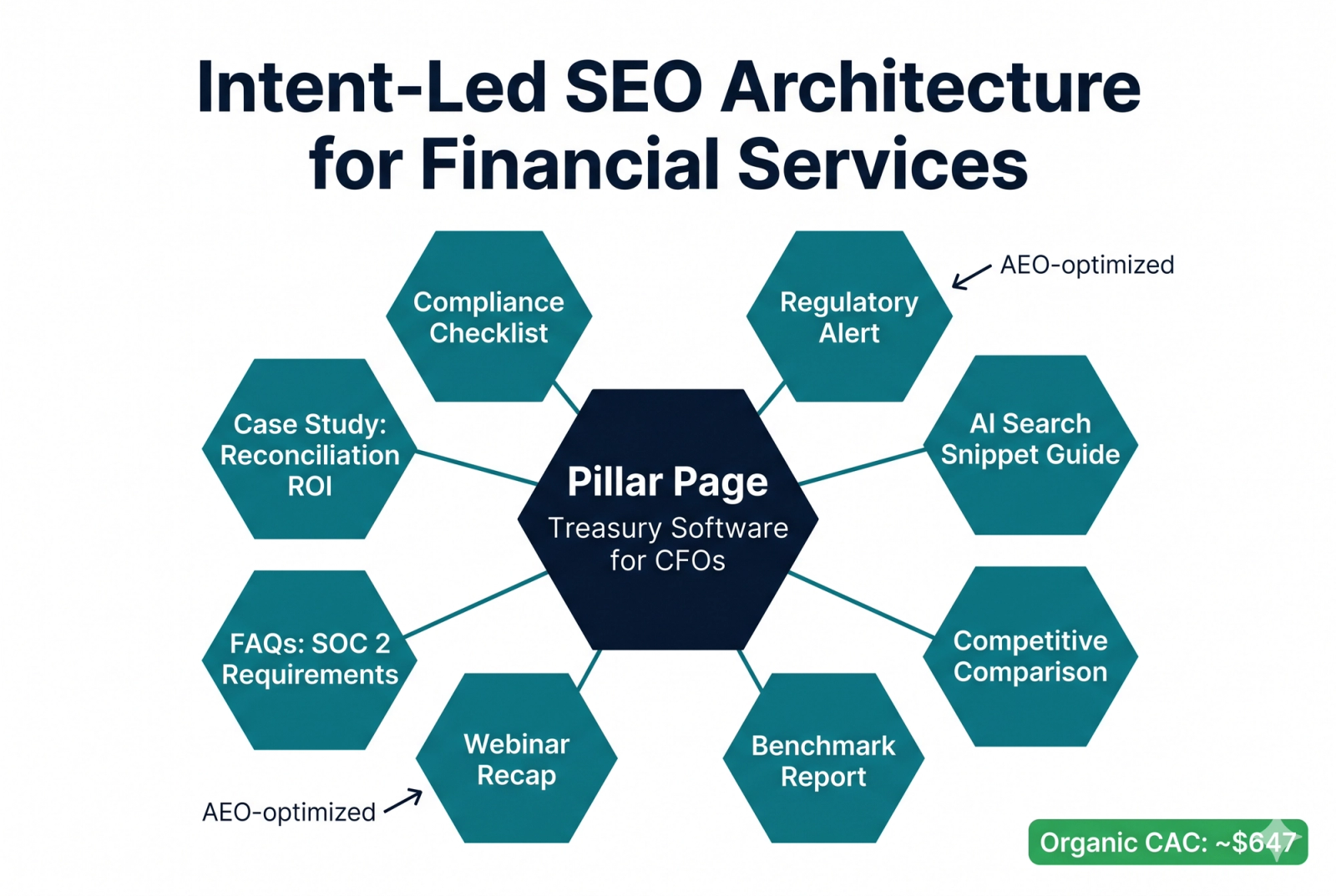
First Page Sage benchmarks B2B CAC for thought-leadership SEO at approximately $647 – roughly one-seventh the cost of ABM ($4,664) and well below paid search ($802–$1,180). For firms selling to SMB or mid-market accounts, that gap translates directly to margin.
Intent-led SEO works differently from standard content marketing. Instead of publishing broad educational articles, you map content to the specific searches of buyers who are already evaluating vendors. Searches like "best treasury management platform for community banks" or "FINRA-compliant CRM for RIAs" carry clear purchase signals.
Three priorities for execution:
Build topical clusters around core product categories. A single authoritative hub page backed by 8–12 supporting articles signals to search engines that you are the subject-matter leader in that niche.
Publish thought leadership that addresses regulatory concerns. Articles referencing compliance considerations, fiduciary standards, or risk frameworks attract the buyers who make or heavily influence purchase decisions in financial services.
Optimize for AI-assisted search (AEO). Generative search surfaces direct answers for many financial queries. Structuring content with clear definitions, comparison tables, and FAQ sections increases the probability your content appears in those placements.
ProGrowth's AI-assisted content production for fintechs supports high-volume, strategically sound organic pipeline at mid-market pricing. Learn more about lead generation for fintechs.
Strategy 2: Compliance-Ready Paid Funnels (Creative Differentiation Beats Targeting)
Paid search and social still belong in a financial services lead-gen stack. They don't, however, work the way they did in 2022.
Targeting options for financial audiences have narrowed on Meta and Google due to regulatory pressure around sensitive categories. LinkedIn tightened its Professional Trust Initiative rules for 2026, requiring claim substantiation, stricter consent processes for Lead Gen Forms, and creative that meets a Professional Relevance Score threshold.
The practical implication: creative differentiation now does more work than audience targeting.
Research from Platinum Prospects confirms this shift – firms that lead with distinct, educational creative outperform companies that rely on precise demographic targeting without differentiated messaging.
For financial services, compliance-ready creative means:
Include mandated disclosures (APR, fees, licensing IDs) within the ad unit itself – not buried in landing-page fine print
Use specific, substantiable claims ("reduce reconciliation time by 30%") rather than vague superlatives
Match landing page compliance language to ad copy consistently – both regulators and platforms flag discrepancies
On budget allocation: Google Ads for financial services currently runs $802–$1,180 CAC for B2B accounts. That works when organic programs carry long-tail volume and paid covers high-intent competitor terms alongside retargeting.
ProGrowth's performance marketing services are built around this organic-plus-paid balance for regulated industries.
Strategy 3: LinkedIn and ABM for Wealth and Commercial Segments
ABM carries the highest CAC of any channel – approximately $4,664 per acquisition in B2B (First Page Sage, 2026). For commercial banking, treasury, or enterprise wealth management, the economics still work when average deal values run $50,000–$500,000+.
The error most teams make is running ABM like a volume play. ABM works as a precision play against a defined account list.
A practical ABM setup for financial services:
Account profiling before anything else. Build complete firmographic and technographic profiles for your top 50–150 target accounts. Map the buying committee – for enterprise fintech deals, this typically includes the CFO, procurement lead, compliance officer, and business unit head. Distinguish who influences from who decides.
LinkedIn Sponsored Content for awareness. Target by job title, company, and seniority within your account list. Use educational creative (white papers, benchmarks, event invitations) – not product pitches. Financial buyers filter out promotional content quickly.
Pre-clear vendor-risk friction. Compliance and security gates block demos in financial services more consistently than any other sector. A publicly accessible trust center, SOC 2 documentation, and a completed SIG or CAIQ-lite questionnaire removes this friction before your sales team makes first contact.
Personalized outreach sequences. After awareness exposure, personalized email and LinkedIn InMail sequences referencing account-specific pain points move prospects toward a conversation. Generic sequences fail at this stage.
For RIAs and independent financial advisors working smaller AUM segments, LinkedIn organic combined with targeted InMail campaigns produces strong CPL at lower absolute spend. The financial advisor-specific setup is outlined at ProGrowth's financial advisor lead generation page.
Strategy 4: Webinars and Gated Education for Regulated Buyers
Trust is the conversion mechanism in financial services. Prospects convert because they believe you understand their regulatory environment, their risk tolerances, and their clients – not because they saw an ad.
Webinars serve a role no other format replicates: live, interactive evidence of expertise.
The data supports the investment. Financial services webinars average 40–60% registration-to-attendance rates, 15–25% attendee-to-lead conversion, and 20–40% of registrants entering a sales conversation within 90 days – when the post-event follow-up sequence runs properly.
What separates high-converting financial webinars:
Regulatory framing in the title. "How Community Banks Are Meeting CRA Compliance Goals in 2026" attracts the compliance officer. "How to Generate More Deposits" does not. Specificity signals depth.
Gated content exchange at registration. Offer a downloadable benchmark report, compliance checklist, or ROI calculator. This pre-qualifies attendees by willingness to share contact data and job context.
Structured post-webinar nurture. Send the follow-up within 24–48 hours. Segment by attendance (live vs. registrant-only) and engagement signals during the session. Route high-engagement attendees directly to an SDR call. Place lower-engagement contacts into a longer nurture sequence.
Compliance review in the content calendar. Every claim in a financial services webinar should survive a FINRA or FCA review. Build the review step into your production schedule – not as a last-minute gate.
Strategy 5: Marketing Automation for Consistent Lead Nurture
Most financial services marketing teams generate leads they never properly follow up on. Marketing-qualified leads go cold when no structured follow-up sequence exists – particularly for contacts that aren't ready to buy immediately.
Marketing automation solves this without adding headcount.
Core automation workflows for financial services:
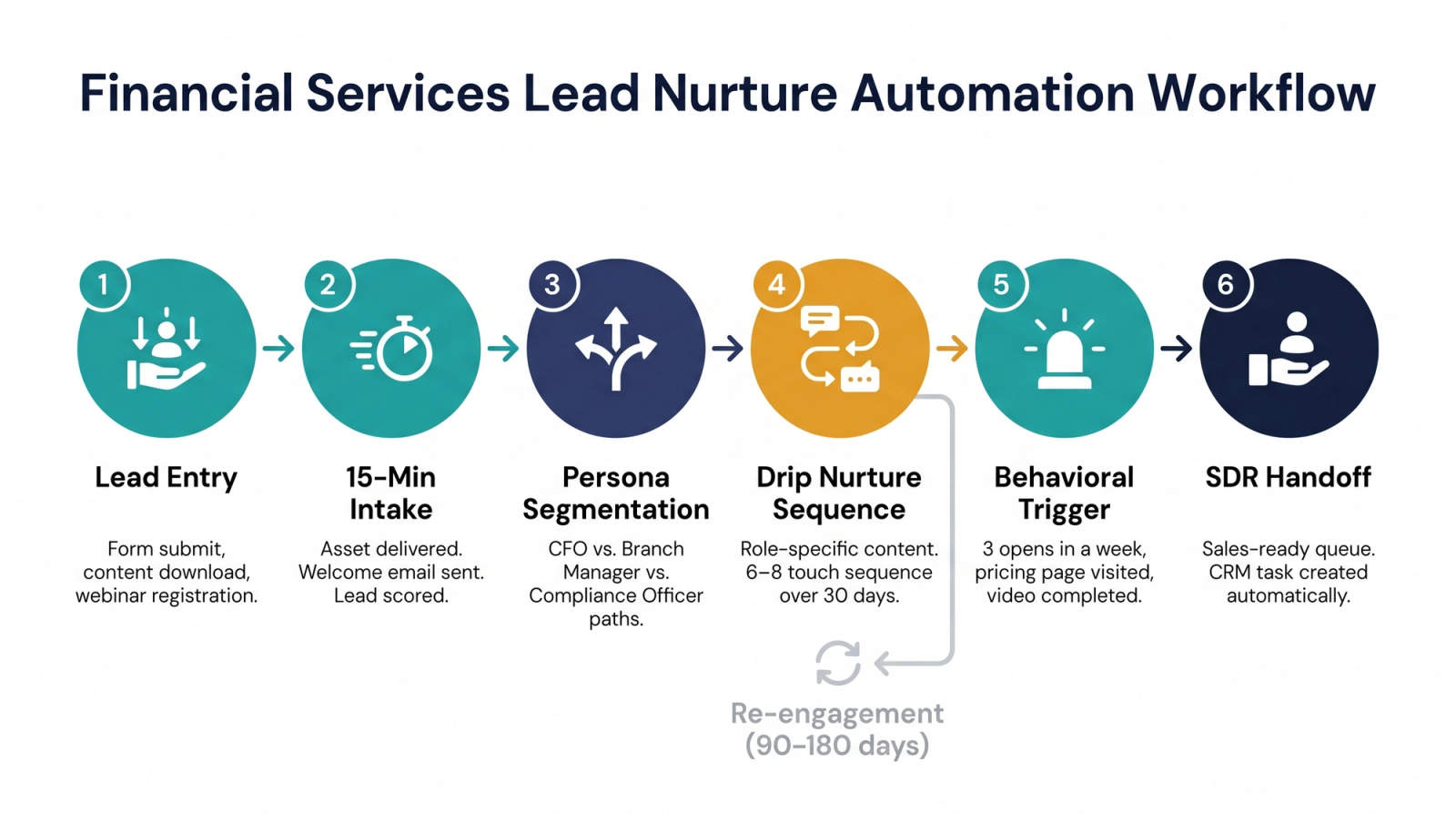
New lead intake and routing. When a lead submits a form or downloads a content asset, an automated sequence starts within 15 minutes. The first message delivers the promised asset and sets follow-up expectations.
Drip nurture segmented by persona. A CFO evaluating treasury software needs different content than a branch manager reviewing a lending platform. Segment sequences by role and product interest from the first touchpoint.
Behavioral trigger sequences. When a nurtured contact re-engages (three email opens in a week, a repeat pricing-page visit, a product video completion), the automation escalates that contact to a sales-ready queue – without any manual review required.
Re-engagement campaigns for stale leads. Leads from 90–180 days prior often contain more sales-qualified contacts than fresh cold lists. A structured re-engagement workflow with new content assets recovers pipeline that otherwise stays dormant in the CRM.
Strategy 6: Lead Scoring to Lift Qualified Appointments
Not every lead deserves an SDR's time. Financial services sales cycles run 6–24 months at enterprise level. Wasted outreach is wasted runway – not just wasted budget.
Lead scoring separates contacts ready for a sales conversation from those still in education mode.
AI-assisted predictive scoring models now deliver 20–30% improvement in lead conversion and 28% higher MQL-to-SQL conversion compared to manual scoring, according to 2025–2026 benchmarks. Well-calibrated hybrid scoring (firmographic fit plus behavioral intent) targets a 25–45% MQL-to-SQL conversion rate. Predictive scoring also cuts cost per qualified lead by 25–40% versus rule-based targeting.
A practical lead scoring framework for financial services:
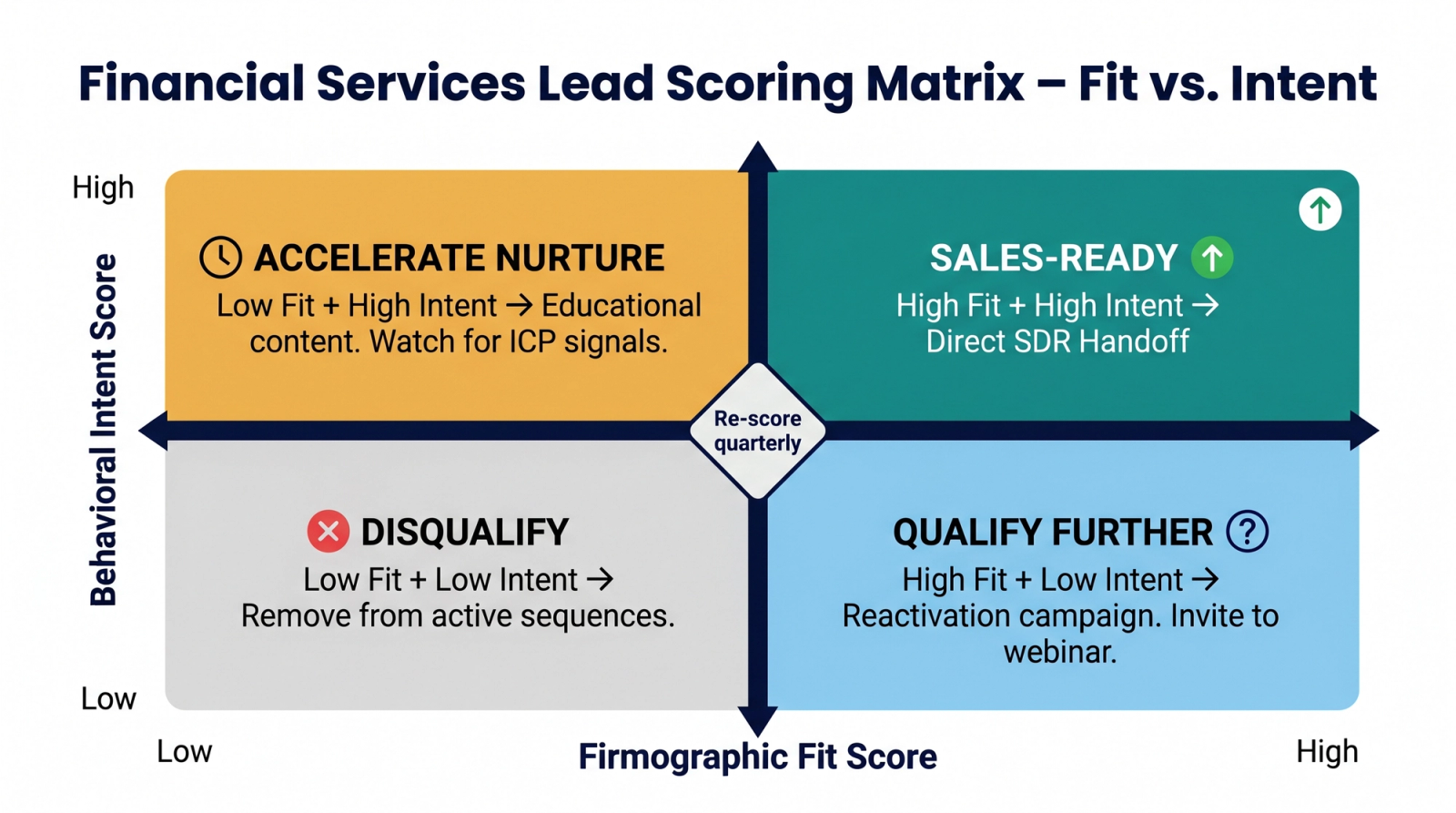
Fit signals (firmographic): Company size, AUM range, revenue band, industry sub-vertical, regulatory jurisdiction
Fit signals (role-based): Job title, seniority level, decision-making authority
Behavioral intent signals: Pages visited (pricing, case studies, compliance documentation), content downloaded, email engagement, webinar attendance, repeat site visits within 30 days
Negative signals: Competitor domains, academic email addresses, geographies outside target markets
Score thresholds should route contacts into one of three tracks: sales-ready (direct SDR handoff), nurture (automated marketing touch), or disqualified (removed from active sequences). Reviewing these thresholds quarterly keeps the model accurate as your ICP evolves.
Strategy 7: Measure CPL and LTV:CAC by Channel
Financial services companies with the lowest blended CAC share one practice: they measure at the channel level, not the campaign level.
Channel-level measurement reveals which programs generate leads that actually close and retain – not just which campaigns produce the most raw volume.
The key metric is LTV:CAC by channel – not CPL in isolation. A $200 CPL from paid social looks more attractive than a $650 CPL from thought-leadership SEO until you examine close rates and customer retention. Organic leads in financial services close at higher rates and carry longer retention periods because they arrive already educated.
The healthy LTV:CAC ratio target for financial services is 3:1 – you spend $1 to generate $3 in lifetime revenue. At that ratio, there's enough margin to absorb overhead, onboarding costs, and variance before acquisition economics turn unprofitable.
CAC-by-Channel Benchmarks for Financial Services (2026)
Different lead generation channels produce very different customer acquisition costs (CAC), lead quality, and time-to-conversion outcomes in financial services.
Thought-leadership SEO continues to deliver one of the strongest long-term returns, with an average B2B CAC of around $647. While it typically takes 3–9 months to generate momentum, the leads are usually high-intent and high-trust, making this channel especially effective for wealth management, treasury management, and commercial banking services. Compliance complexity also remains relatively low compared to paid acquisition channels.
Email marketing and automation workflows typically generate CAC in the range of $204–$310. Results can appear within days or weeks when existing databases and behavioral segmentation are already in place. Lead quality ranges from medium to high, particularly when combined with lead scoring and personalized nurture sequences.
Referral and partner programs remain one of the lowest-cost acquisition channels, averaging around $150–$300 CAC. Although growth may be gradual and ongoing rather than campaign-driven, referred prospects generally convert at much higher rates and produce stronger lifetime value.
Webinars and gated educational content usually produce CAC between $320–$480. These campaigns often take a few weeks to build traction but work extremely well in regulated industries where buyers require education before making decisions. Lead quality is typically high because prospects voluntarily exchange contact information for specialized insights.
Paid search campaigns, including Google Ads, generally generate CAC between $802–$1,180 in financial services verticals. While paid search can drive leads quickly, increasing competition and rising fintech advertising costs have made efficiency optimization essential.
Cold outbound and SDR-led prospecting commonly ranges from $900–$1,500 CAC. Although outreach can generate immediate conversations, lead quality varies significantly depending on targeting accuracy, messaging relevance, and personalization depth.
LinkedIn Ads and account-based marketing (ABM) remain among the most expensive acquisition strategies, averaging approximately $4,664 CAC. However, these campaigns can still deliver strong ROI for enterprise banking, treasury, and institutional financial products where deal sizes are significantly larger.
According to benchmarks from First Page Sage and Prospeo, the combination of organic SEO, marketing automation, and AI-assisted lead scoring consistently produces the lowest blended CAC while maintaining strong lead quality. This combination is particularly effective for financial institutions operating in high-trust B2B segments.
90-Day Implementation Roadmap
Phase 1: Foundation (Weeks 1–4)
The first month should focus on building a reliable measurement and operational foundation. Financial services companies should begin by auditing current acquisition channels and calculating channel-specific CAC, conversion rates, and sales velocity.
At the same time, teams should configure CRM systems, implement lead scoring frameworks, and establish automation workflows for email nurturing and appointment booking. Creating a structured editorial calendar for SEO and thought leadership content is also critical during this stage.
The primary goal during this phase is to establish accurate measurement infrastructure and eliminate reporting gaps.
Phase 2: Build (Weeks 5–8)
Once the infrastructure is in place, the next step is activating demand-generation channels.
This phase typically includes publishing an intent-led SEO content cluster consisting of four to six high-value articles targeting transactional and commercial search intent. Companies should also launch automated nurture sequences, host their first educational webinar, and increase LinkedIn organic publishing frequency.
The focus during this stage is building a scalable pipeline generation engine rather than maximizing immediate lead volume.
Phase 3: Accelerate (Weeks 9–12)
During the final month, organizations can begin scaling the highest-performing channels.
Key activities include launching paid search retargeting campaigns, activating ABM programs targeting top-priority accounts, refining lead scoring thresholds based on engagement data, and measuring LTV:CAC ratios by channel.
The objective in this phase is improving qualified pipeline volume while maintaining acquisition efficiency and compliance standards.
Most financial services teams complete the Foundation phase internally. The Build and Accelerate phases require either dedicated marketing headcount or an external partner who can compress the platform learning curve.
How ProGrowth Lowers Your Blended CAC
The seven strategies above work. The gap between knowing what to execute and executing it at the pace your pipeline requires is where most financial services marketing teams stall.
ProGrowth's fractional CMO model combined with an AI-assisted execution stack addresses that gap directly. Rather than building an in-house team ($90K–$300K+ annually before benefits) or hiring a general-purpose agency ($25K+ per month in retainers), you get senior B2B financial services marketing leadership with the execution capacity to run organic, automation, and paid channels in parallel.
This approach lowered blended CPL by 25–45% for ProGrowth's financial services clients across B2B fintech and financial advisor segments. It also compresses the infrastructure build – instead of spending 6–9 months building marketing systems from scratch, the Foundation phase completes in weeks.
If your CAC is climbing and your pipeline is inconsistent, the right starting point is a channel-level audit – mapping your current lead sources against the benchmarks in this guide and identifying where the highest-ROI opportunities sit for your specific segment.
Book a lead-gen audit with the ProGrowth team and get a clear view of where your acquisition costs can come down.
Never Miss Our Latest Insights
Get exclusive B2B marketing strategies, AI automation tips, and growth tactics delivered straight to your inbox every week.
We respect your privacy. Unsubscribe at any time.